By Nancy A. Youssef
Knight Ridder Newspapers
HADITHA, Iraq - In the middle of methodically recalling the day his brother's family was killed, Yaseen's monotone voice and stream of tears suddenly stopped. He looked up, paused and pleaded: "Please don't let me say anything that will get me killed by the Americans. My family can't handle any more."
The story of what happened to Yaseen and his brother Younes' family has redefined Haditha's relationship with the Marines who patrol it. On Nov. 19, a roadside bomb struck a Humvee on Haditha's main road, killing one Marine and injuring two others.
The Marines say they took heavy gunfire afterwards and thought it was coming from the area around Younes' house. They went to investigate, and 23 people were killed.
Eight were from Younes' family. The only survivor, Younes' 13-year-old daughter, said her family wasn't shooting at Marines or harboring extremists that morning. They were sleeping when the bomb exploded. And when the Marines entered their house, she said, they shot at everyone inside.
The Navy Criminal Investigative Service (NCIS) began an investigation in February after a Time Magazine reporter passed on accounts he had received about the incident. A second investigation was opened into how the Marines initially reported the killings - the Marines said that 15 people were killed by the roadside explosion and that eight insurgents were killed in subsequent combat.
On Friday, the Marines relieved of duty three leaders of the 3rd Battalion, 1st Marine Regiment, which had responsibility for Haditha when the shooting occurred. They are Lt. Col. Jeffrey R. Chessani, commander of the 3rd Battalion, 1st Marine Regiment, and two of his company commanders, Capt. James S. Kimber and Capt. Lucas M. McConnell. McConnell was commanding Kilo Company of the 3rd Battalion, the unit that struck the roadside bomb on Nov. 19 and led the subsequent search of the area.
The Marines' announcement didn't tie the disciplinary actions directly to Haditha, saying only that Maj. Gen. Richard Natonski, commanding general of the 1st Marine Division, had lost confidence in the officers' ability to command.
They were relieved because of "multiple incidents that occurred throughout their deployment," said Lt. Lawton King, a spokesman at the Marines' home base at Camp Pendleton, Calif., to which they recently returned. "This decision was made independent of the NCIS investigation."
The events of last November have clearly taken their toll on Yaseen and his niece, Safa, who trembles visibly as she listens to Yaseen recount what she told him of the attack. She cannot bring herself to tell the tale herself.
She fainted after the Marines burst through the door and began firing. When she regained consciousness, only her 3-year-old brother was still alive, but bleeding heavily. She comforted him in a room filled with dead family members until he died, too. And then she went to her Uncle Yaseen's house next door.
Neither Yaseen nor Safa have returned home since.
Indeed, many in this town, whose residents are stuck in the battle between extremists and the Americans, said now it is the U.S. military they fear most.
"The mujahadeen (holy warriors) will kill you if you stand against them or say anything against them. And the Americans will kill you if the mujahadeen attack them several kilometers away," said Mohammed al-Hadithi, 32, a barber who lives in neighboring Haqlania. With a cigarette between his fingers, he pointed at a Marine patrol as it passed in front of his shop. "I look at each of them, and I see killers."
Haditha, a town of about 100,000 people in Anbar province, undeniably is an insurgent bastion. Around the time of the attack, several storefronts were lined with posters and pictures supporting al-Qaida, although residents said they posted them to appease extremists.
Insurgents blend in with the residents, setting up their cells in homes next to those belonging to everyday citizens, some of them supportive.
There is no functioning police station and the government offices are largely vacant. The last man to call himself mayor relinquished the title earlier this year after scores of death threats from insurgents.
The military wouldn't release statistics, but attacks on U.S. troops are frequent.
Indeed, Haditha has been the site of some of the deadliest attacks against U.S. forces. On Aug. 1, six Marine reservists were killed in an ambush; two days later, a roadside bomb killed 14 Marines traveling in an amphibious assault vehicle just outside the town, the deadliest single attack ever on U.S. forces.
On Nov. 19, according to military spokeswoman Lt. Col. Michelle Martin-Hing, the Marines were hit four separate times by roadside bombs and were fired on multiple times by gunmen they couldn't see.
Three years after the war began, the U.S. military concedes it hasn't figured out how to tell a terrorist from an ordinary citizen in places like Haditha.
-continue-
2006/04/11


Phone-Jamming Records Point to White House
By LARRY MARGASAK
WASHINGTON Apr 11, 2006 (AP)— Republican officials describe the two-dozen calls to the White House around Election Day 2002 as normal conversations about a close Senate race in New Hampshire.
Democrats have suggested in a court filing that another subject was discussed: a GOP scheme that jammed phone lines to keep state Democrats from being encouraged to vote.
The phone-jamming operation has led to three federal convictions and a pending indictment. Prosecutors have not raised questions in court about the White House conversations but records of the calls were available to them as criminal court exhibits.
The records show that Republican campaign operative James Tobin, who recently was convicted in the case, made two dozen calls to the White House within a three-day period around Election Day 2002 as the jamming operation was finalized, carried out and then abruptly shut down.
The national Republican Party, which paid millions in legal bills to defend Tobin, says it was "preposterous" to suggest the calls involved phone jamming.
Democrats have filed a motion asking a federal judge to order GOP and White House officials to answer questions about the phone jamming. The filing is part of the Democrats' civil lawsuit that alleges Republican voter fraud and seeks monetary damages.
Repeated hang-up calls that jammed telephone lines at a Democratic get-out-the-vote center occurred in the race that brought victory to GOP Sen. John Sununu. He defeated Democrat Jeanne Shaheen, 51 percent to 46 percent, on Nov. 5, 2002.
Besides the conviction of Tobin, the Republicans' New England regional director, prosecutors negotiated two plea bargains: one with a New Hampshire Republican Party official and another with the owner of a telemarketing firm involved in the scheme. The owner of the subcontractor firm whose employees made the hang-up calls is under indictment.
The phone records show that most calls to the White House were from Tobin, who became President Bush's presidential campaign chairman for the New England region in 2004. Other calls from New Hampshire senatorial campaign offices to the White House could have been made by a number of people.
-continued-
WASHINGTON Apr 11, 2006 (AP)— Republican officials describe the two-dozen calls to the White House around Election Day 2002 as normal conversations about a close Senate race in New Hampshire.
Democrats have suggested in a court filing that another subject was discussed: a GOP scheme that jammed phone lines to keep state Democrats from being encouraged to vote.
The phone-jamming operation has led to three federal convictions and a pending indictment. Prosecutors have not raised questions in court about the White House conversations but records of the calls were available to them as criminal court exhibits.
The records show that Republican campaign operative James Tobin, who recently was convicted in the case, made two dozen calls to the White House within a three-day period around Election Day 2002 as the jamming operation was finalized, carried out and then abruptly shut down.
The national Republican Party, which paid millions in legal bills to defend Tobin, says it was "preposterous" to suggest the calls involved phone jamming.
Democrats have filed a motion asking a federal judge to order GOP and White House officials to answer questions about the phone jamming. The filing is part of the Democrats' civil lawsuit that alleges Republican voter fraud and seeks monetary damages.
Repeated hang-up calls that jammed telephone lines at a Democratic get-out-the-vote center occurred in the race that brought victory to GOP Sen. John Sununu. He defeated Democrat Jeanne Shaheen, 51 percent to 46 percent, on Nov. 5, 2002.
Besides the conviction of Tobin, the Republicans' New England regional director, prosecutors negotiated two plea bargains: one with a New Hampshire Republican Party official and another with the owner of a telemarketing firm involved in the scheme. The owner of the subcontractor firm whose employees made the hang-up calls is under indictment.
The phone records show that most calls to the White House were from Tobin, who became President Bush's presidential campaign chairman for the New England region in 2004. Other calls from New Hampshire senatorial campaign offices to the White House could have been made by a number of people.
-continued-
'You're an a--hole'

An Alabama high-school science teacher has landed in hot water for showing a controversial anti-Bush video to his students.
The video is set up like a film strip, showing slides of Bush and his cronies while a song called "A--hole" plays in the background.
The word appears numerous times in the video, which is about as clever and entertaining as your average hippie war protester carrying a "Bush=Hitler" sign. (Watch it!)
Parents were steamed when they found out that teacher Steve White had exposed their children to this type of vulgarity.
"My son and a group of his friends were talking about this video they had seen in school," Christy Jackson told the Athens News-Courier.
"One of the other student's mother saw the video and she forwarded it to me. I saw it and I became livid."
She called up the school and was told that White had been reprimanded.
"I think he should admit he was wrong and he should apologize," she continued.
"I'm really not out to get anybody fired, but I think a lesson needs to be learned and I don't want any teacher showing my son anything that is not clean or related to his studies."
White, in addition to teaching eighth-grade science, is a Democratic candidate for the state House of Representatives. His District 4 opponent, Congressman Micky Harmmon, accused White of abusing kids' trust: "I know he's my opponent, but I would say this about any teacher who showed something like that. You shouldn't use your position as a teacher to influence children about your political opinions.
"That is wrong. He's abusing his authority."
Since the news broke, more allegations have emerged against White. According to the News-Courier, "One parent said an obscene video showing an animated Bill Clinton was shown to students."
Tomb of Jesus' babies

This Easter is turning out to be especially grim for those who worship a virgin Jesus who was executed and then came back from the dead.
Between the outrageous heresy of the Gospel of Judas, disturbing scientific investigations of Jesus' alleged crucifixion, mundane explanations for his miracles and the latest media circus around "The Da Vinci Code" and "Holy Blood, Holy Grail," it was already a very bad spring for Christians.
It just got worse. A stunning new book by religious-history archeologist Dr. James A. Tabor -- "The Jesus Dynasty: A New Historical Investigation of Jesus, His Royal Family, and the Birth of Christianity" -- went on sale this week.
Early gossip about the book said Dr. Tabor would theorize that Jesus was not a spiritual savior for gentiles but a radical Jewish royalist.
Jesus only intended to seize the throne from the puppet king installed by the Roman occupation forces.
His family dynasty would continue to rule even after his death.
That's all there, but it follows shocking revelations of 2,000-year-old tombs found in Jerusalem, including one ancient tomb that holds an entire family: Mary, Joseph, a second Mary, Jude the son of Jesus, Matthew and Jesus the son of Joseph.
And then it gets even more painful for the Christian faithful.
According to Tabor, early Greek and Hebrew mentions of the infamous rabbi Jesus called him by a name unknown to modern believers: Jesus bar Pantera.
Just as Osama bin Laden means "Osama, son of Laden," the name Jesus bar Pantera means "Jesus, son of Pantera."
Dr. Tabor points to a grave on the German frontier where a 62-year-old Roman soldier was buried some 40 years after the traditional date of Jesus' execution. That soldier would've been 19 or 20 years old when Mary got pregnant. And Tabor says that soldier was stationed in Palestine at the time, because Pantera (or Pandera or Panthera) was himself from the region and even served as a soldier in Palestine.
The Virgin Mary didn't just have sex with the soldier, however. According to Tabor and other scholars, Pantera was just one of at least three men who had sexual intercourse with the Virgin Mary -- including her very angry husband Joseph, who was not thrilled to find out a Roman soldier got her pregnant.
-Oh shit were all going to Hell!!!!!-
2006/04/10
Royal Brutality: Army beat up Medical Students

The doctors, staffs and students of Teaching Hospital have joined the protest and were on strike yesterday. In an act of taking revenge the royal army infiltrated students hostel at the middle of night.
The army used batons, boots and fists to beat up sleeping students injuring dozens of them, some seriously. The injured students then were no admitted to Teaching hospital but taken to Police hospital.
Other students of teaching hospital went to Police hospital this morning and brought back the injured to their hospital and are being treated there
I guess this is just a exageration too, just like the things in China. I mean the picture is obviously fake. Nothin like this would actually ever happen in this perfect world of ours.
Base Crimes
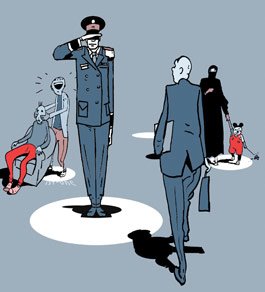
The military has a domestic violence problem.
By Karen Houppert
AT NORTH CAROLINA’S Fort Bragg this February, Army Special Forces trainee Richard Corcoran got mad at his estranged wife, Michele. He’d gotten mad before, but this would mark the sixth and final time the Cumberland County Sheriffs Department would be called to break up a “domestic disturbance” between Corcoran and his wife. At 8:30 p.m. Corcoran arrived at his wife’s house and went after 30-year-old Michele with a gun, firing at her as she fled to a neighbor’s. (She was wounded but survived.) He shot and wounded another Fort Bragg soldier who was in the house and then shot and killed himself—all while his seven-month-old daughter lay in another room.
He joins a band of brothers. Corcoran’s is the 10th fatality in a slew of domestic violence homicides involving Fort Bragg soldiers since 2002; in one six-week spree four Army wives were murdered by their husbands or ex-husbands. Including nonfatal incidents, there were 832 victims of domestic violence between 2002 and 2004 at Fort Bragg alone, according to Army figures.
And yet Corcoran’s attack stands out. Not only had he just attended a mandated anger-management class on-post that same afternoon—calling into question the efficacy of these sessions that the Army considers the cornerstone of its domestic violence treatment program—but Corcoran had a past that should have kept him out of the Army in the first place: He had been indicted for rape at the age of 19.
On March 1, 1989, in the town of Glen Ridge, New Jersey, Corcoran and six other high school athletes sexually assaulted a retarded girl with sticks and a baseball bat. Corcoran, like all the boys, admitted being present but insisted he just watched. Four of the boys were tried and convicted in a grueling five-month trial. Three days before Corcoran’s trial was slated to begin in 1994, the victim’s parents decided it was not in their daughter’s best interest to pursue another trial. The case against Corcoran, son of a Glen Ridge police lieutenant, was dropped.
Several years later, Richard Corcoran joined the Army.
-continued-
Global Inc. Goes Green
By Bill McKibben
May/June 2005 Issue
"George Bush has created a bubble where the U.S. believes it can live according to rules and understanding from the last century," says environmentalist Bob Massie. "That bubble may last another four years," he says, "but eventually America's charade that we live in some other time and place will come to an end. It could come to an end abruptly, as the result of some kind of crisis, or more slowly, as the realities of the rest of the world begin to penetrate our borders again." Massie is a senior fellow with Ceres (formerly called the Coalition for Environmentally Responsible Economies), a group of socially responsible investment companies and advocacy groups. Working with business on climate change, Massie knows as well as anyone that many corporations are uncomfortable living in the Bush bubble.
Among some U.S.-based multinational companies, there is a growing sense that living in two different realities—the one here and the one prevailing in the rest of the world—may be more trouble than it's worth. Several dozen firms, from Alcoa to Weyerhaeuser, have endorsed a set of principles proffered by the Pew Center on Global Climate Change. The principles are hardly radical ("We accept the views of most scientists that enough is known for us to take actions to address" climate change.), but they're a far cry from Bush administration dogma.
"Companies have had a kind of forced schizophrenia put upon them," says Massie, who was one of the first environmentalists to work extensively with big corporations like Ford. "In the U.S. they're supposed to act as if it's not a serious problem, as if carbon will never have a price. But everywhere else in the world they're being asked to operate in an environment where carbon does carry a cost, where those who can increase their efficiencies will gain financially, both directly and because they'll have technologies people want to buy."
-continued-
May/June 2005 Issue
"George Bush has created a bubble where the U.S. believes it can live according to rules and understanding from the last century," says environmentalist Bob Massie. "That bubble may last another four years," he says, "but eventually America's charade that we live in some other time and place will come to an end. It could come to an end abruptly, as the result of some kind of crisis, or more slowly, as the realities of the rest of the world begin to penetrate our borders again." Massie is a senior fellow with Ceres (formerly called the Coalition for Environmentally Responsible Economies), a group of socially responsible investment companies and advocacy groups. Working with business on climate change, Massie knows as well as anyone that many corporations are uncomfortable living in the Bush bubble.
Among some U.S.-based multinational companies, there is a growing sense that living in two different realities—the one here and the one prevailing in the rest of the world—may be more trouble than it's worth. Several dozen firms, from Alcoa to Weyerhaeuser, have endorsed a set of principles proffered by the Pew Center on Global Climate Change. The principles are hardly radical ("We accept the views of most scientists that enough is known for us to take actions to address" climate change.), but they're a far cry from Bush administration dogma.
"Companies have had a kind of forced schizophrenia put upon them," says Massie, who was one of the first environmentalists to work extensively with big corporations like Ford. "In the U.S. they're supposed to act as if it's not a serious problem, as if carbon will never have a price. But everywhere else in the world they're being asked to operate in an environment where carbon does carry a cost, where those who can increase their efficiencies will gain financially, both directly and because they'll have technologies people want to buy."
-continued-
U.S. in Iraq: Returning to the Scene of the Crime
The American occupation in the context of war crimes
By Noam Chomsky
April 4, 2006
[This piece is adapted from Chapter 2 of Noam Chomsky's newest book, Failed States: The Abuse of Power and the Assault on Democracy (New York: Metropolitan Books, 2006).]
In 2002, White House counsel Alberto Gonzales passed on to Bush a memorandum on torture by the Justice Department's Office of Legal Counsel (OLC). As noted by constitutional scholar Sanford Levinson: "According to the OLC, ‘acts must be of an extreme nature to rise to the level of torture… Physical pain amounting to torture must be equivalent in intensity to the pain accompanying serious physical injury, such as organ failure, impairment of bodily function, or even death.'" Levinson goes on to say that in the view of Jay Bybee, then head of the OLC, "The infliction of anything less intense than such extreme pain would not, technically speaking, be torture at all. It would merely be inhuman and degrading treatment, a subject of little apparent concern to the Bush administration's lawyers."
Gonzales further advised President Bush to effectively rescind the Geneva Conventions, which, despite being "the supreme law of the land" and the foundation of contemporary international law, contained provisions Gonzales determined to be "quaint" and "obsolete." Rescinding the conventions, he informed Bush, "substantially reduces the threat of domestic criminal prosecution under the War Crimes Act." Passed in 1996, the act carries severe penalties for "grave breaches" of the conventions: the death penalty, "if death results to the victim" of the breach. Gonzales was later appointed to be attorney general and would probably have been a Supreme Court nominee if Bush's constituency did not regard him as "too liberal."
How to Destroy a City to Save It
Gonzales's legal advice about protecting Bush from the threat of prosecution under the War Crimes Act was proven sound not long after he gave it, in a case far more severe even than the torture scandals. In November 2004, U.S. occupation forces launched their second major attack on the city of Falluja. The press reported major war crimes instantly, with approval. The attack began with a bombing campaign intended to drive out all but the adult male population; men ages fifteen to forty-five who attempted to flee Falluja were turned back. The plans resembled the preliminary stage of the Srebrenica massacre, though the Serb attackers trucked women and children out of the city instead of bombing them out. While the preliminary bombing was under way, Iraqi journalist Nermeen al-Mufti reported from "the city of minarets [which] once echoed the Euphrates in its beauty and calm [with its] plentiful water and lush greenery… a summer resort for Iraqis [where people went] for leisure, for a swim at the nearby Habbaniya lake, for a kebab meal." She described the fate of victims of these bombing attacks in which sometimes whole families, including pregnant women and babies, unable to flee, along with many others, were killed because the attackers who ordered their flight had cordoned off the city, closing the exit roads.
-continued-
By Noam Chomsky
April 4, 2006
[This piece is adapted from Chapter 2 of Noam Chomsky's newest book, Failed States: The Abuse of Power and the Assault on Democracy (New York: Metropolitan Books, 2006).]
In 2002, White House counsel Alberto Gonzales passed on to Bush a memorandum on torture by the Justice Department's Office of Legal Counsel (OLC). As noted by constitutional scholar Sanford Levinson: "According to the OLC, ‘acts must be of an extreme nature to rise to the level of torture… Physical pain amounting to torture must be equivalent in intensity to the pain accompanying serious physical injury, such as organ failure, impairment of bodily function, or even death.'" Levinson goes on to say that in the view of Jay Bybee, then head of the OLC, "The infliction of anything less intense than such extreme pain would not, technically speaking, be torture at all. It would merely be inhuman and degrading treatment, a subject of little apparent concern to the Bush administration's lawyers."
Gonzales further advised President Bush to effectively rescind the Geneva Conventions, which, despite being "the supreme law of the land" and the foundation of contemporary international law, contained provisions Gonzales determined to be "quaint" and "obsolete." Rescinding the conventions, he informed Bush, "substantially reduces the threat of domestic criminal prosecution under the War Crimes Act." Passed in 1996, the act carries severe penalties for "grave breaches" of the conventions: the death penalty, "if death results to the victim" of the breach. Gonzales was later appointed to be attorney general and would probably have been a Supreme Court nominee if Bush's constituency did not regard him as "too liberal."
How to Destroy a City to Save It
Gonzales's legal advice about protecting Bush from the threat of prosecution under the War Crimes Act was proven sound not long after he gave it, in a case far more severe even than the torture scandals. In November 2004, U.S. occupation forces launched their second major attack on the city of Falluja. The press reported major war crimes instantly, with approval. The attack began with a bombing campaign intended to drive out all but the adult male population; men ages fifteen to forty-five who attempted to flee Falluja were turned back. The plans resembled the preliminary stage of the Srebrenica massacre, though the Serb attackers trucked women and children out of the city instead of bombing them out. While the preliminary bombing was under way, Iraqi journalist Nermeen al-Mufti reported from "the city of minarets [which] once echoed the Euphrates in its beauty and calm [with its] plentiful water and lush greenery… a summer resort for Iraqis [where people went] for leisure, for a swim at the nearby Habbaniya lake, for a kebab meal." She described the fate of victims of these bombing attacks in which sometimes whole families, including pregnant women and babies, unable to flee, along with many others, were killed because the attackers who ordered their flight had cordoned off the city, closing the exit roads.
-continued-
Cutting and Running in Baghdad
The "D" word—as in "defeat"—could be with us for a while.
By Robert Dreyfuss
April 6, 2006
It didn't take long after the invasion of Iraq began in March 2003 for one of the radioactive words of the Vietnam era to make its first appearance, even if in stunted, referential form. Media pundits, former military men, and others began fretting, even as American soldiers advanced, about the "Q word." They were, of course, worrying about entering the infamous "quagmire" -- the word many Americans had applied to Vietnam as the war there dragged on and on and on. Three years after the fall of Baghdad, with the Bush administration well into their Iraqi version of the quagmire, a couple of letters closer to the ultimate ABCs of political life, are now making their appearance. And little wonder.
Both of these probably began their journey from the political Internet into the mainstream in mid-February when, of all people, conservative icon William F. Buckley raised them both in a near-tombstone op-ed published in the National Review and entitled It Didn't Work. With that single piece, you could promptly add "D" and "F" to the Iraq alphabet. "One can't doubt that the American objective in Iraq has failed," Buckley wrote and in a single bound, "failure" made it onto the list of the Bush administration's official ills in Iraq. "Iraqi animosities," he added, "have proved uncontainable by an invading army of 130,000 Americans." Buckley then suggested that the President had somehow to admit to this reality in order to ensure "the survival" of his larger "strategic policies." Offering a final line of advice, he ended: "And the kernel here is the acknowledgment of defeat."
Defeat. The unthinkable. Call it the dreaded "D" word. And suddenly on the scene was the part of the Vietnam era that the President's high officials and neocon supporters never considered in their wildest dreams and so never spent a day preparing contingency plans for. Now, like it or not, believe it or not, they are in terra incognita and, to mix metaphors, visibly at sea.
-continued-
By Robert Dreyfuss
April 6, 2006
It didn't take long after the invasion of Iraq began in March 2003 for one of the radioactive words of the Vietnam era to make its first appearance, even if in stunted, referential form. Media pundits, former military men, and others began fretting, even as American soldiers advanced, about the "Q word." They were, of course, worrying about entering the infamous "quagmire" -- the word many Americans had applied to Vietnam as the war there dragged on and on and on. Three years after the fall of Baghdad, with the Bush administration well into their Iraqi version of the quagmire, a couple of letters closer to the ultimate ABCs of political life, are now making their appearance. And little wonder.
Both of these probably began their journey from the political Internet into the mainstream in mid-February when, of all people, conservative icon William F. Buckley raised them both in a near-tombstone op-ed published in the National Review and entitled It Didn't Work. With that single piece, you could promptly add "D" and "F" to the Iraq alphabet. "One can't doubt that the American objective in Iraq has failed," Buckley wrote and in a single bound, "failure" made it onto the list of the Bush administration's official ills in Iraq. "Iraqi animosities," he added, "have proved uncontainable by an invading army of 130,000 Americans." Buckley then suggested that the President had somehow to admit to this reality in order to ensure "the survival" of his larger "strategic policies." Offering a final line of advice, he ended: "And the kernel here is the acknowledgment of defeat."
Defeat. The unthinkable. Call it the dreaded "D" word. And suddenly on the scene was the part of the Vietnam era that the President's high officials and neocon supporters never considered in their wildest dreams and so never spent a day preparing contingency plans for. Now, like it or not, believe it or not, they are in terra incognita and, to mix metaphors, visibly at sea.
-continued-
Avoiding Defeat on Human Rights
Commentary: The decision not to seek a seat on the Human Rights Council indicates how far U.S. credibility has fallen at the United Nations
By Jeffrey Laurenti
April 7, 2006
After the Bush administration’s multiple failures to forge common policy with its allies and developing countries at the United Nations on Iraq, nuclear proliferation, human rights, and UN reform, it has at last made a strategically sound decision: the United States will not run for a seat on the UN’s newly constituted Human Rights Council.
The administration’s decision wisely acknowledges that the president’s personal representative to the UN, conservative firebrand John Bolton, cannot win an election for the United States in the General Assembly—not even in the Western group. Rather than face a humiliating defeat at the hands of Portugal or Greece, the administration will not seek a seat for the United States at all.
While politically realistic, the decision not to run constitutes a damning admission that the administration’s belligerent policies have squandered America ’s global leadership. The one-time leader of the Free World and the planet’s pioneering constitutional democracy cannot muster half the votes in an assembly where democracies now constitute the majority.
Administration policies have blighted America’s traditional reputation as a leader on human rights. A government forfeits that mantle when it countenances torture, on graphic display at Abu Ghraib; secretly renders Muslim-surnamed individuals to torturers among Arab secret police; refuses to permit UN rights monitors to see detainees at Guantanamo who have been imprisoned for years but not accounted for; and refuses to compel states to honor consular obligations to foreign nationals accused of capital crimes.
Even with the heavy burden of its arch-conservative policies, the United States could still salvage a majority vote if it had serious diplomatic representation at the United Nations that practiced the politics of coalition-building rather than polarization. We can sustain coalitions if our representatives act as if they believe that the United States shares the aspirations of most of humankind for peace and security, disarmament, improved living standards, and a sustainable environment.
-continued-
By Jeffrey Laurenti
April 7, 2006
After the Bush administration’s multiple failures to forge common policy with its allies and developing countries at the United Nations on Iraq, nuclear proliferation, human rights, and UN reform, it has at last made a strategically sound decision: the United States will not run for a seat on the UN’s newly constituted Human Rights Council.
The administration’s decision wisely acknowledges that the president’s personal representative to the UN, conservative firebrand John Bolton, cannot win an election for the United States in the General Assembly—not even in the Western group. Rather than face a humiliating defeat at the hands of Portugal or Greece, the administration will not seek a seat for the United States at all.
While politically realistic, the decision not to run constitutes a damning admission that the administration’s belligerent policies have squandered America ’s global leadership. The one-time leader of the Free World and the planet’s pioneering constitutional democracy cannot muster half the votes in an assembly where democracies now constitute the majority.
Administration policies have blighted America’s traditional reputation as a leader on human rights. A government forfeits that mantle when it countenances torture, on graphic display at Abu Ghraib; secretly renders Muslim-surnamed individuals to torturers among Arab secret police; refuses to permit UN rights monitors to see detainees at Guantanamo who have been imprisoned for years but not accounted for; and refuses to compel states to honor consular obligations to foreign nationals accused of capital crimes.
Even with the heavy burden of its arch-conservative policies, the United States could still salvage a majority vote if it had serious diplomatic representation at the United Nations that practiced the politics of coalition-building rather than polarization. We can sustain coalitions if our representatives act as if they believe that the United States shares the aspirations of most of humankind for peace and security, disarmament, improved living standards, and a sustainable environment.
-continued-
The Art of War for the anti-war movement
Posted by Scott Ritter at 6:13 PM on March 31, 2006.
It's high time to recognize that we as a nation are engaged in a life-or-death struggle of competing ideologies with those who promote war as an American value and virtue.
In the months leading up to the invasion of Iraq by a US-led coalition, and for three years since, I have spent many hours speaking to numerous anti-war forums across the country and around the world. I have always been struck by the sincerity of the vast majority of those who call themselves anti-war, and impressed by their willingness to give so much of themselves in the service of such a noble cause.
Whether participating in demonstrations, organizing a vigil, conducting town-hall meetings, or writing letters to their elected officials and the media, the participants in the anti-war movement have exhibited an energy and integrity that would make anyone proud. For myself, I have been vociferous in my defense of the actions of the majority of the anti-war movement, noting that the expression of their views is not only consistent with their rights afforded by the Constitution of the United States, but also that their engagement in the process of citizenship is a stellar example of the ideals and values set forth in that document, and as such representative of the highest form of patriotism in keeping with service to a document that begins, "We the People."
Lately I have noticed a growing despondency among many of those who call themselves the anti-war movement. With the United States now entering its fourth year of illegal war in and illegitimate occupation of Iraq, and the pro-war movement moving inexorably towards yet another disastrous conflict with Iran, there is an increasing awareness that the cause of the anti-war movement, no matter how noble and worthy, is in fact a losing cause as currently executed. Despite all of the well-meaning and patriotic work of the millions of activists and citizens who comprise the anti-war movement, America still remains very much a nation not only engaged in waging and planning wars of aggression, but has also become a nation which increasingly identifies itself through its military and the wars it fights. This is a sad manifestation of the fact that the American people seem to be addicted to war and violence, rather than the ideals of human rights, individual liberty, and freedom and justice for all that should define our nation.
In short, the anti-war movement has come face to face with the reality that in the ongoing war of ideologies that is being waged in America today, their cause is not just losing, but is in fact on the verge of complete collapse. Many in the anti-war movement would take exception to such a characterization of the situation, given the fact that there seems to be a growing change in the mood among Americans against the ongoing war in Iraq. But one only has to scratch at the surface of this public discontent to realize how shallow and superficial it is. Americans aren't against the war in Iraq because it is wrong; they are against it because we are losing.
Take the example of Congressman Jack Murtha. A vocal supporter of President Bush's decision to invade Iraq, last fall Mr. Murtha went public with his dramatic change of position, suddenly rejecting the war as un-winnable, and demanding the immediate withdrawal of American troops from Iraq. While laudable, I have serious problems with Jack Murtha's thought process here. At what point did the American invasion of Iraq become a bad war? When we suffered 2,000 dead? After two years of fruitless struggle? Once we spent $100 billion?
While vocalizing his current opposition against the Iraq War, Congressman Murtha and others who voted for the war but now question its merits have never retracted their original pro-war stance. Nor have they criticized their role in abrogating the Constitutional processes for bringing our country into conflict when they voted for a war before the President had publicly committed to going to war (we now know the President had committed to the invasion of Iraq by the summer of 2002, and that all his representations to the American people and Congress about 'war as a matter of last resort' and 'seeking a diplomatic solution' were bold face lies). The Iraq War was wrong the moment we started bombing Iraq. Getting rid of Saddam Hussein is no excuse, and does not pardon America's collective sin of brooking and tolerating an illegal war of aggression.
It's high time to recognize that we as a nation are engaged in a life-or-death struggle of competing ideologies with those who promote war as an American value and virtue.
In the months leading up to the invasion of Iraq by a US-led coalition, and for three years since, I have spent many hours speaking to numerous anti-war forums across the country and around the world. I have always been struck by the sincerity of the vast majority of those who call themselves anti-war, and impressed by their willingness to give so much of themselves in the service of such a noble cause.
Whether participating in demonstrations, organizing a vigil, conducting town-hall meetings, or writing letters to their elected officials and the media, the participants in the anti-war movement have exhibited an energy and integrity that would make anyone proud. For myself, I have been vociferous in my defense of the actions of the majority of the anti-war movement, noting that the expression of their views is not only consistent with their rights afforded by the Constitution of the United States, but also that their engagement in the process of citizenship is a stellar example of the ideals and values set forth in that document, and as such representative of the highest form of patriotism in keeping with service to a document that begins, "We the People."
Lately I have noticed a growing despondency among many of those who call themselves the anti-war movement. With the United States now entering its fourth year of illegal war in and illegitimate occupation of Iraq, and the pro-war movement moving inexorably towards yet another disastrous conflict with Iran, there is an increasing awareness that the cause of the anti-war movement, no matter how noble and worthy, is in fact a losing cause as currently executed. Despite all of the well-meaning and patriotic work of the millions of activists and citizens who comprise the anti-war movement, America still remains very much a nation not only engaged in waging and planning wars of aggression, but has also become a nation which increasingly identifies itself through its military and the wars it fights. This is a sad manifestation of the fact that the American people seem to be addicted to war and violence, rather than the ideals of human rights, individual liberty, and freedom and justice for all that should define our nation.
In short, the anti-war movement has come face to face with the reality that in the ongoing war of ideologies that is being waged in America today, their cause is not just losing, but is in fact on the verge of complete collapse. Many in the anti-war movement would take exception to such a characterization of the situation, given the fact that there seems to be a growing change in the mood among Americans against the ongoing war in Iraq. But one only has to scratch at the surface of this public discontent to realize how shallow and superficial it is. Americans aren't against the war in Iraq because it is wrong; they are against it because we are losing.
Take the example of Congressman Jack Murtha. A vocal supporter of President Bush's decision to invade Iraq, last fall Mr. Murtha went public with his dramatic change of position, suddenly rejecting the war as un-winnable, and demanding the immediate withdrawal of American troops from Iraq. While laudable, I have serious problems with Jack Murtha's thought process here. At what point did the American invasion of Iraq become a bad war? When we suffered 2,000 dead? After two years of fruitless struggle? Once we spent $100 billion?
While vocalizing his current opposition against the Iraq War, Congressman Murtha and others who voted for the war but now question its merits have never retracted their original pro-war stance. Nor have they criticized their role in abrogating the Constitutional processes for bringing our country into conflict when they voted for a war before the President had publicly committed to going to war (we now know the President had committed to the invasion of Iraq by the summer of 2002, and that all his representations to the American people and Congress about 'war as a matter of last resort' and 'seeking a diplomatic solution' were bold face lies). The Iraq War was wrong the moment we started bombing Iraq. Getting rid of Saddam Hussein is no excuse, and does not pardon America's collective sin of brooking and tolerating an illegal war of aggression.
Beyond Capitalism: Problems and Solutions
By Charles Sullivan 04/10/06 "ICH" -- --
Too often my neoconservative detractors accuse me of being a whining liberal eager to point out problems but short on solutions. While I would argue that has never been the case, the following is one man’s attempt to not only clearly define some of our most pressing social problems, but also to provide practical solutions. These solutions, while not easy, can provide a way out of the hell we are creating for ourselves. There are no guarantees that any of them will work; although I believe they will if enough people participate. What I am certain they will do, however, is offer hope. To do nothing and allow matters to run their course is certain to destroy not only our country but also much of the world. That would be unforgivable. During the height of the great depression of the late 1920-30s, Franklin D. Roosevelt changed the face of America by giving us the ‘New Deal.’ Roosevelt’s New Deal created the present Social Security system, the Securities and Exchange Commission and the Civilian Conservation Corps, along with a wealth of other programs of social uplift. These social programs were intended to lift the nation out of the depression and to put people to work rebuilding the nation’s crumbling infrastructure. Because of its benefit to working class people and to the common good, Roosevelt’s New Deal has been under assault since its inception: a process that continues to this day. The idea of an American president giving aide to the nation’s working class was more than some conservatives could stomach. Roosevelt’s detractors declared that he was “a traitor to his class.” Between the years 1929-1933 the unemployment rate rose from 4% to 25%. Fortunately, Roosevelt’s economic policies worked as intended. They lifted the nation out of depression and put the nation back on its feet. Millions of the unemployed went back to work which in turn stimulated the economy. Social security is a concept borrowed from socialism in that it provides for the common good rather than the more customary privatized wealth of capitalism. No one will ever accuse George Bush of being a traitor to his class. Bush’s self proclaimed political base consists of the wealthiest one percent of the population; and he has rewarded them handsomely for their financial support. You see, elites think of themselves as privileged; more deserving of wealth than the rest of us. The elite believe they are our moral and intellectual superiors as a right of birth, like royalty. Thus, in only a few years of transparent class warfare Bush has managed to turn the huge budget surplus he inherited into the greatest national debt in history. At the same time he has essentially bankrupted the nation both economically and morally. During this time of economic downturn suffered by working people (the fat cats on Wall Street are still making money), Bush has managed to provide enormous welfare to the rich by stealing from the poor. His every policy is detrimental to working class people while simultaneously beneficial to the wealthy. There can be no question about Bush’s class loyalty, or the class loyalty of those who preceded him into the White House. One might suppose that Bush’s brutish behavior is aberrant. To the contrary, this is exactly how Plutocracy is supposed to work. Those in power maintain their positions of privilege by operating beyond the pale of the law; by enjoying advantages that the rest of us do not. Every policy enacted by Bush demonstrates his attitude of contempt for the common people, as well as for the rule of law. Mr. Bush sees himself as an emperor, not as a servant of the people. The emperor views the people as his servants. He takes from them what he wants and does not hesitate to send them to die in foreign conflicts not of their making. The defining character of the emperor is hubris that knows no bounds and a profound lack of respect for ordinary people in their daily struggles.
Too often my neoconservative detractors accuse me of being a whining liberal eager to point out problems but short on solutions. While I would argue that has never been the case, the following is one man’s attempt to not only clearly define some of our most pressing social problems, but also to provide practical solutions. These solutions, while not easy, can provide a way out of the hell we are creating for ourselves. There are no guarantees that any of them will work; although I believe they will if enough people participate. What I am certain they will do, however, is offer hope. To do nothing and allow matters to run their course is certain to destroy not only our country but also much of the world. That would be unforgivable. During the height of the great depression of the late 1920-30s, Franklin D. Roosevelt changed the face of America by giving us the ‘New Deal.’ Roosevelt’s New Deal created the present Social Security system, the Securities and Exchange Commission and the Civilian Conservation Corps, along with a wealth of other programs of social uplift. These social programs were intended to lift the nation out of the depression and to put people to work rebuilding the nation’s crumbling infrastructure. Because of its benefit to working class people and to the common good, Roosevelt’s New Deal has been under assault since its inception: a process that continues to this day. The idea of an American president giving aide to the nation’s working class was more than some conservatives could stomach. Roosevelt’s detractors declared that he was “a traitor to his class.” Between the years 1929-1933 the unemployment rate rose from 4% to 25%. Fortunately, Roosevelt’s economic policies worked as intended. They lifted the nation out of depression and put the nation back on its feet. Millions of the unemployed went back to work which in turn stimulated the economy. Social security is a concept borrowed from socialism in that it provides for the common good rather than the more customary privatized wealth of capitalism. No one will ever accuse George Bush of being a traitor to his class. Bush’s self proclaimed political base consists of the wealthiest one percent of the population; and he has rewarded them handsomely for their financial support. You see, elites think of themselves as privileged; more deserving of wealth than the rest of us. The elite believe they are our moral and intellectual superiors as a right of birth, like royalty. Thus, in only a few years of transparent class warfare Bush has managed to turn the huge budget surplus he inherited into the greatest national debt in history. At the same time he has essentially bankrupted the nation both economically and morally. During this time of economic downturn suffered by working people (the fat cats on Wall Street are still making money), Bush has managed to provide enormous welfare to the rich by stealing from the poor. His every policy is detrimental to working class people while simultaneously beneficial to the wealthy. There can be no question about Bush’s class loyalty, or the class loyalty of those who preceded him into the White House. One might suppose that Bush’s brutish behavior is aberrant. To the contrary, this is exactly how Plutocracy is supposed to work. Those in power maintain their positions of privilege by operating beyond the pale of the law; by enjoying advantages that the rest of us do not. Every policy enacted by Bush demonstrates his attitude of contempt for the common people, as well as for the rule of law. Mr. Bush sees himself as an emperor, not as a servant of the people. The emperor views the people as his servants. He takes from them what he wants and does not hesitate to send them to die in foreign conflicts not of their making. The defining character of the emperor is hubris that knows no bounds and a profound lack of respect for ordinary people in their daily struggles.
The Great Western Demonology Circus
Now Featuring The Halabja Show
By Gajendra Singh04/10/06 "ICH" -- --
Western leaders and in house corporate and subservient media, continue to line up one show after another. Soon after the death of Serbian nationalist hero Slobodan Milosevic's death in western custody, which ended his trial ( the Hague tribunal did not even allow him to be treated in Moscow ), another third world leader has been put on trial ,Charles Taylor of Liberia . Just a little side show. But, at Anglo-Saxon request, the perennial popular show with the West, Saddam Hussein's trial, is back again , this episode covers gassing of Kurds at Halabja. After all West has expanded so much effort and money on his demonisation to cloak its policies. Make an example of all those who dare oppose US led Western hegemony! In history , this began as soon as the West crossed the Turkish straits , when Mithradates VI of Pontus in Asia was demonized for standing up to Rome. In that conflict 2 millennia ago , the power breaking all the rules was the Roman empire, who ruthlessly exploited and taxed their subjects in Asia, a complaint similar to what the Arabs have about the exploitation of their oil resources, with the connivance of the client rulers. Of course there are no trials of US leadership and British Prime Minister Tony Blair, in spite of illegal invasion of Iraq, proven crimes and violation of almost all international conventions and treaties and even laws at home. 'There were thousands of tactical mistakes' coyly confessed the US face of democracy crusader , Secretary of State Condoleeza Rice , some of which were rightly described by others as strategic blunders. When Pentagon boss Donald Rumsfeld snarled witheringly "I don't know what she was talking about, to be perfectly honest," she mumbled, "I guess I shouldn't use figures of speech." Robert Dreyfuss , an expert on Middle East ,recently described Condi as a leading know-nothing on Iraq – and said that it was her utter ignorance of the Middle East as national security adviser through 2004 that allowed the cabal led by Vice President Dick Cheney and Rumsfeld to get away with so much . It is and, until the US withdrawal from Iraq, the government will remain a collection of charlatans and quislings, leavened with separatist warlords such as the Barzanis and Talabanis of Kurdistan and Abdel Aziz al-Hakim of the Supreme Council for the Islamic Revolution in Iraq (SCIRI). Incumbent Iraqi Prime Minister Ibrahim Al Jaafari, who has been nominated for the post by members of his alliance in the Parliament, elected 4 months ago , refused to withdraw , even after requests in person in Baghdad by Ms Rice and British Foreign Minister Jack Straw to make way for a pro-US candidate. Was not sovereignty transferred to Iraq long time ago! After Bush's ordering of telephone surveillance without legal sanction , Court documents released this week show that I. Lewis ''Scooter" Libby, the former chief of staff for Dick Cheney, testified that both Cheney and President Bush authorized him to leak classified intelligence about Iraq in July 2003. Libby had outed information to the media on the covert CIA officer wife of Ambassador Joseph Wilson to punish him and to warn other whistle blowers .Ambassador Wilson had exposed the administration's claims that Saddam Hussein was getting Uranium cake for his nuclear program from Niger.Boston Globe commented "the next thing you know, President Bush will channel Richard Nixon to say, ''I am not a crook." The clock has started on whether Bush will make this declaration. There is panic in USA about what to do with the mess on its hands in Iraq and the unraveling of the credibility of the Bush Administration. These would adversely affect fortunes of the ruling Republican party in November elections. Another shocker now. Seymour Herse has just disclosed that the Administration has increased clandestine activities inside Iran and intensified planning for a possible major air attack including use of tactical nuclear weapons. Perhaps to also drown the rising whispers of censoring and even impeaching the President. So the Great Western Circus must produce newer or repeat popular shows on third world leaders to divert attention from failures abroad and at home, where popularity of Bush and Blair remains low Nato's War on Serbia and Milosevic Trial ;To give a perspective on western form of perverse entertainment and education of its young and adult minds alike , let us re-visit the demonisation of Slobodan Milosevic and Serbia . I had watched the unraveling of Yugoslavia and Nato led war on Serbia from Ankara and Bucharest and was horrified by western spins , lies and propaganda . Before the Nato led war on Yugoslavia , the then British Defence Minister George Robertson ( he was later made Nato's Secretary General , a normal US practice to reward subservient and loyal British functionaries) said that the war was to "prevent a humanitarian catastrophe" and stop "a regime which is intent on genocide". Genocide word was used many times. US President Bill Clinton referred to "deliberate, systematic efforts at . . . genocide".Countered John Pilger in New Stateman in November , 1999. " The British press took their cue. "FLIGHT FROM GENOCIDE," said a Daily Mail headline over a picture of Kosovar children in a lorry. Both the Sun and Mirror referred to "echoes of the Holocaust". Figures were supplied. The US defence secretary, William Cohen, said: "We've now seen about 100,000 military-aged men missing . . . They may have been murdered." Geoffrey Hoon, then Foreign Office minister, put the Albanian dead at 10,000, adding that "the final toll may be much worse". A widely quoted US Information Agency fact sheet claimed: "The number of unaccounted-for ethnic Albanian men ranges from a low of 225,000 . . . to over 400,000." Cherie Blair told the Sun she was "horrified about the rape camps" But after the war, thousands of western journalists and forensic investigators, found no evidence of mass murder on the scale used to justify the Nato bombing of Serbia. The head of the Spanish forensic team attached to the International Criminal Tribunal, Emilio Perez Pujol, said that as few as 2,500 were killed .He told Al Pais" I called my people together and said, 'We're finished here.' I informed my government and told them the real situation. We had found a total of 187 bodies." He complained angrily that he and colleagues had become part of "a semantic pirouette by the war propaganda machines, because we did not find one – not one – mass grave".
-continued-
Who polices the police???
By Gajendra Singh04/10/06 "ICH" -- --
Western leaders and in house corporate and subservient media, continue to line up one show after another. Soon after the death of Serbian nationalist hero Slobodan Milosevic's death in western custody, which ended his trial ( the Hague tribunal did not even allow him to be treated in Moscow ), another third world leader has been put on trial ,Charles Taylor of Liberia . Just a little side show. But, at Anglo-Saxon request, the perennial popular show with the West, Saddam Hussein's trial, is back again , this episode covers gassing of Kurds at Halabja. After all West has expanded so much effort and money on his demonisation to cloak its policies. Make an example of all those who dare oppose US led Western hegemony! In history , this began as soon as the West crossed the Turkish straits , when Mithradates VI of Pontus in Asia was demonized for standing up to Rome. In that conflict 2 millennia ago , the power breaking all the rules was the Roman empire, who ruthlessly exploited and taxed their subjects in Asia, a complaint similar to what the Arabs have about the exploitation of their oil resources, with the connivance of the client rulers. Of course there are no trials of US leadership and British Prime Minister Tony Blair, in spite of illegal invasion of Iraq, proven crimes and violation of almost all international conventions and treaties and even laws at home. 'There were thousands of tactical mistakes' coyly confessed the US face of democracy crusader , Secretary of State Condoleeza Rice , some of which were rightly described by others as strategic blunders. When Pentagon boss Donald Rumsfeld snarled witheringly "I don't know what she was talking about, to be perfectly honest," she mumbled, "I guess I shouldn't use figures of speech." Robert Dreyfuss , an expert on Middle East ,recently described Condi as a leading know-nothing on Iraq – and said that it was her utter ignorance of the Middle East as national security adviser through 2004 that allowed the cabal led by Vice President Dick Cheney and Rumsfeld to get away with so much . It is and, until the US withdrawal from Iraq, the government will remain a collection of charlatans and quislings, leavened with separatist warlords such as the Barzanis and Talabanis of Kurdistan and Abdel Aziz al-Hakim of the Supreme Council for the Islamic Revolution in Iraq (SCIRI). Incumbent Iraqi Prime Minister Ibrahim Al Jaafari, who has been nominated for the post by members of his alliance in the Parliament, elected 4 months ago , refused to withdraw , even after requests in person in Baghdad by Ms Rice and British Foreign Minister Jack Straw to make way for a pro-US candidate. Was not sovereignty transferred to Iraq long time ago! After Bush's ordering of telephone surveillance without legal sanction , Court documents released this week show that I. Lewis ''Scooter" Libby, the former chief of staff for Dick Cheney, testified that both Cheney and President Bush authorized him to leak classified intelligence about Iraq in July 2003. Libby had outed information to the media on the covert CIA officer wife of Ambassador Joseph Wilson to punish him and to warn other whistle blowers .Ambassador Wilson had exposed the administration's claims that Saddam Hussein was getting Uranium cake for his nuclear program from Niger.Boston Globe commented "the next thing you know, President Bush will channel Richard Nixon to say, ''I am not a crook." The clock has started on whether Bush will make this declaration. There is panic in USA about what to do with the mess on its hands in Iraq and the unraveling of the credibility of the Bush Administration. These would adversely affect fortunes of the ruling Republican party in November elections. Another shocker now. Seymour Herse has just disclosed that the Administration has increased clandestine activities inside Iran and intensified planning for a possible major air attack including use of tactical nuclear weapons. Perhaps to also drown the rising whispers of censoring and even impeaching the President. So the Great Western Circus must produce newer or repeat popular shows on third world leaders to divert attention from failures abroad and at home, where popularity of Bush and Blair remains low Nato's War on Serbia and Milosevic Trial ;To give a perspective on western form of perverse entertainment and education of its young and adult minds alike , let us re-visit the demonisation of Slobodan Milosevic and Serbia . I had watched the unraveling of Yugoslavia and Nato led war on Serbia from Ankara and Bucharest and was horrified by western spins , lies and propaganda . Before the Nato led war on Yugoslavia , the then British Defence Minister George Robertson ( he was later made Nato's Secretary General , a normal US practice to reward subservient and loyal British functionaries) said that the war was to "prevent a humanitarian catastrophe" and stop "a regime which is intent on genocide". Genocide word was used many times. US President Bill Clinton referred to "deliberate, systematic efforts at . . . genocide".Countered John Pilger in New Stateman in November , 1999. " The British press took their cue. "FLIGHT FROM GENOCIDE," said a Daily Mail headline over a picture of Kosovar children in a lorry. Both the Sun and Mirror referred to "echoes of the Holocaust". Figures were supplied. The US defence secretary, William Cohen, said: "We've now seen about 100,000 military-aged men missing . . . They may have been murdered." Geoffrey Hoon, then Foreign Office minister, put the Albanian dead at 10,000, adding that "the final toll may be much worse". A widely quoted US Information Agency fact sheet claimed: "The number of unaccounted-for ethnic Albanian men ranges from a low of 225,000 . . . to over 400,000." Cherie Blair told the Sun she was "horrified about the rape camps" But after the war, thousands of western journalists and forensic investigators, found no evidence of mass murder on the scale used to justify the Nato bombing of Serbia. The head of the Spanish forensic team attached to the International Criminal Tribunal, Emilio Perez Pujol, said that as few as 2,500 were killed .He told Al Pais" I called my people together and said, 'We're finished here.' I informed my government and told them the real situation. We had found a total of 187 bodies." He complained angrily that he and colleagues had become part of "a semantic pirouette by the war propaganda machines, because we did not find one – not one – mass grave".
-continued-
Who polices the police???
White House intruder!
Police nabbed a weirdo who jumped the fence onto White House grounds, screaming that he was a "victim of terrorism."
The man wore a tee shirt reading "God Bless America" and claimed that his family was being poisoned in New Mexico.
He made it a pretty good distance before getting caught. During an armed standoff with Secret Service agents, he continued yelling his head off.
"I have intelligence information for the president," he declared.
After his arrest, authorities discovered an "item" he'd left behind. After careful investigation on the part of D.C. firefighters, the item was identified as a jacket.
The man wore a tee shirt reading "God Bless America" and claimed that his family was being poisoned in New Mexico.
He made it a pretty good distance before getting caught. During an armed standoff with Secret Service agents, he continued yelling his head off.
"I have intelligence information for the president," he declared.
After his arrest, authorities discovered an "item" he'd left behind. After careful investigation on the part of D.C. firefighters, the item was identified as a jacket.
Fence greased to keep kids on campus
An Artesia, California high school principal kicked off a firestorm of criticism with his efforts to keep kids on campus two weeks ago. He was trying to keep the kids from running off to join the immigration demonstrations across the state.
Principal Sergio Garcia feels that part of his job is to keep the kids safe and the best way to do that is to keep them on campus. So in the hopes of stopping students from leaving campus, he ordered the chain-link fence surrounding the school grounds be lubed up with wheel-bearing grease.
He warned the students ahead of time that the fence would be greased up on March 27, the day of the protests. Nonetheless, several students tried to scale the fence, only to come away covered in greasy slime.
Despite Garcia's efforts, more than 300 kids managed to cross the border.
Parents' are kids are furious.
"I just don't think it's appropriate," parent Sylvia Gooden told the ABC Unified School District board during a meeting Tuesday.
District deputy superintendent Mary Sieu supports Garcia's extreme measures.
"I think that at that time, (Garcia) was trying to hold off any other students" from leaving the campus for unsafe areas, Sieu said.
Principal Sergio Garcia feels that part of his job is to keep the kids safe and the best way to do that is to keep them on campus. So in the hopes of stopping students from leaving campus, he ordered the chain-link fence surrounding the school grounds be lubed up with wheel-bearing grease.
He warned the students ahead of time that the fence would be greased up on March 27, the day of the protests. Nonetheless, several students tried to scale the fence, only to come away covered in greasy slime.
Despite Garcia's efforts, more than 300 kids managed to cross the border.
Parents' are kids are furious.
"I just don't think it's appropriate," parent Sylvia Gooden told the ABC Unified School District board during a meeting Tuesday.
District deputy superintendent Mary Sieu supports Garcia's extreme measures.
"I think that at that time, (Garcia) was trying to hold off any other students" from leaving the campus for unsafe areas, Sieu said.
France scraps youth job law, bowing to mass unrest
By Elizabeth Pineau
PARIS (Reuters) - French President Jacques Chirac on Monday scrapped a planned youth job law that provoked weeks of protests, in a climbdown opponents celebrated as an unqualified victory.
The move was a personal blow to Prime Minister Dominique de Villepin, who had championed the First Job Contract (CPE) and seen his popularity slump with the mass opposition and unrest.
In a televised statement, Villepin said he regretted that weeks of strikes and protests showed the CPE could not be applied but gave no details about his own political future, on the line over his handling of the dispute.
"The necessary conditions of confidence and calm are not there, either among young people, or companies, to allow the application of the First Job Contract," Villepin said, adding he would open talks with unions on youth employment.
Students had planned fresh marches for Tuesday and it was unclear if they would call off their strikes and a blockade of many universities and high schools after the announcement.
Villepin championed the CPE contract as a means of reducing youth unemployment and saw his poll ratings plunge as opposition to the measures mounted, damaging his chances of becoming the ruling UMP party's candidate for president in elections in 2007.
"The president of the republic has decided to replace article 8 of the equal opportunities law with measures to help disadvantaged young people find work," an earlier statement from the presidency said.
"CPE IS DEAD"
-continued-
PARIS (Reuters) - French President Jacques Chirac on Monday scrapped a planned youth job law that provoked weeks of protests, in a climbdown opponents celebrated as an unqualified victory.
The move was a personal blow to Prime Minister Dominique de Villepin, who had championed the First Job Contract (CPE) and seen his popularity slump with the mass opposition and unrest.
In a televised statement, Villepin said he regretted that weeks of strikes and protests showed the CPE could not be applied but gave no details about his own political future, on the line over his handling of the dispute.
"The necessary conditions of confidence and calm are not there, either among young people, or companies, to allow the application of the First Job Contract," Villepin said, adding he would open talks with unions on youth employment.
Students had planned fresh marches for Tuesday and it was unclear if they would call off their strikes and a blockade of many universities and high schools after the announcement.
Villepin championed the CPE contract as a means of reducing youth unemployment and saw his poll ratings plunge as opposition to the measures mounted, damaging his chances of becoming the ruling UMP party's candidate for president in elections in 2007.
"The president of the republic has decided to replace article 8 of the equal opportunities law with measures to help disadvantaged young people find work," an earlier statement from the presidency said.
"CPE IS DEAD"
-continued-
2006/04/09
FNJ: journalists arrested, one beaten, others released

UPDATE - NEPAL
7 April 2006
Protesting journalists and others covering protests arrested, one beaten; journalists arrested on
6 April released
SOURCE:
 Federation of Nepalese Journalists (FNJ), Kathmandu
(FNJ/IFEX) - Five journalists were arrested at 7:45 a.m. (local time) on 7 April 2006 in Hetuada, while participating in a peaceful rally organized by the Professional Alliance for Peace and Democracy (PAPAD) and other professional organizations to protest the arrests of journalists and professionals over the prior two days. Police also charged at protestors with batons.
The arrested journalists were Khem Bolakhe, FNJ secretary, Makwanpur Branch; Gokarna Adhikari, FNJ treasurer; Girija Adhikari of “Pratik Dainik”; Sunil Khadka of “Nikash Weekly”; and Hari Humagain of “Hetauda Shandesh”. Also arrested at the protest were: Dhruba Chaulagain, president, Appellate court bar unit; Purushottam Baniya, president, PAPAD, Makwanpur Chapter; and Rajan Mainali, secretary, Peace Society.
All are being detained at the District Police Office in Makwanpur.
In a separate incident, a journalist was arrested on 7 April while reporting on the democratic movement organized by the seven party alliance in Srijana Chowk, Pokhara. Tribhuwan Paudel - executive member, FNJ, Kaski Chapter, and reporter for Pokhra-based “Annapurna FM”, “Pokhra Hotline” and “Himal Khabar online” - was arrested at 10:00 a.m. (local time).
According to Rabinda Bastola - FNJ president, Kaski Chapter - Paudyal was arrested when he tried to protest the arrest of human rights activists at the rally. He is being held in the police barracks at Pokhara.
Madhav Basnet, correspondent of “Dristi Weekly”, was severely beaten by the police at around 4:30 p.m. on 7 April at Gongabu, Kathmandu. Basnet was severely injured on his right leg and hand. The incident took place while Basnet was reporting on the democratic movement organized by the seven party alliance.
According to Binod Pahadi, central committee member of the FNJ, Basnet was beaten by the police despite having shown them his identity card. Basnet was taken home after having his injured leg and hand attended to.
Central representatives of the FNJ were also arrested on 6 April in Kathmandu: Shudarshan Acharya; Bhaktadhowj Bhohara; Shyam Badan KC, editor, “Kathmandu Shandhaykalin”; and Kamal Koirala, chief editor, “Roadmap weekly”. Journalist Laxmi Prasain, chief editor, “Kutumba Weekly”, was also arrested from his house on 5 April. They were arrested for their involvement in the protest organized by the FNJ. Acharya and Bohara were detained at a women’s training academy in Jawalakhel.
In another incident, unidentified individuals vandalized a vehicle belonging to the “Himalayan Times” at Barahisthan of Bhaktapur on 6 April. The incident took place when the vehicle was en route to Surya Vinayak to drop home members of the newspaper’s editorial department.
The attackers hurled stones at the vehicle, shattering its windows; however, the driver and occupants escaped injury. Later, the same vehicle was attacked by another group of unidentified people at Tinkune, in Kathmandu.
All the journalists arrested in Ilam and Parsa on 6 April were released in the evening of the same day.
For further information contact Mr. R. B. Khatry, Executive Director at FNJ, Media Village, Tilganga, Kathmandu, Nepal, tel: +977 1 449 0063, or +977 1 449 3873, fax: +977 1 449 0085, e-mail: fnjnepal@mail.com.np, Internet: http://www.fnjnepal.org
The information contained in this update is the sole responsibility of FNJ. In citing this material for broadcast or publication, please credit FNJ.
Prison Official Rapped For Brokeback
A Massachusetts prison officer faces discipline for showing the gay cowboy movie "Brokeback Mountain" to inmates at the state's largest prison because the film includes content “inappropriate for a prison setting”.
Massachusetts Department of Correction spokeswoman Diane Wiffin said that the action was not related to the critically acclaimed film's plot involving a gay love affair. "It was not the subject matter. It was the graphic nature of sexually explicit scenes," Wiffin said.
She said the officer failed to follow prison guidelines that require staff who schedule films to review them in advance for excessive violence, nudity or sex, or scenes involving assaults on correctional staff.
The officer showed the film on Thursday, two days after its American release on DVD, to inmates at a prison in Norfolk, Massachusetts, about 25 miles southwest of Boston.Wiffin declined to discuss his punishment.
"Brokeback Mountain" is about two men who meet and fall in love while wrangling sheep in Wyoming in 1963. It won three Oscars last month, including one for director Ang Lee.
Massachusetts Department of Correction spokeswoman Diane Wiffin said that the action was not related to the critically acclaimed film's plot involving a gay love affair. "It was not the subject matter. It was the graphic nature of sexually explicit scenes," Wiffin said.
She said the officer failed to follow prison guidelines that require staff who schedule films to review them in advance for excessive violence, nudity or sex, or scenes involving assaults on correctional staff.
The officer showed the film on Thursday, two days after its American release on DVD, to inmates at a prison in Norfolk, Massachusetts, about 25 miles southwest of Boston.Wiffin declined to discuss his punishment.
"Brokeback Mountain" is about two men who meet and fall in love while wrangling sheep in Wyoming in 1963. It won three Oscars last month, including one for director Ang Lee.
Prude-in-chief
Secretary of State Condoleezza Rice is such a miserable prude that she had Playboy and Penthouse yanked from State Department area newsstands when she took office there.
"The secretary wanted them gone immediately," said her senior adviser, Jim Wilkinson. "She didn't understand how a department that claimed to fight for the rights of women worldwide could sell pornography that degrades women."
Such smut-peddlers as John Updike, Norman Mailer, Joyce Carol Oates, Gabriel Garcia Marquez, and historian Arthur Schlesinger, Jr. have published their filth in the pages of Playboy.
At the Secretary's behest, two newsstands did a purge of the salacious materials. But now that Playboy and Penthouse are gone, some women at State are looking to get rid of Maxim and FHM.
Don't expect that to happen any time soon. Hard-core porn might not be flying off the shelves, but according to State News's Richard Williams, "Maxim is a bestseller."
"The secretary wanted them gone immediately," said her senior adviser, Jim Wilkinson. "She didn't understand how a department that claimed to fight for the rights of women worldwide could sell pornography that degrades women."
Such smut-peddlers as John Updike, Norman Mailer, Joyce Carol Oates, Gabriel Garcia Marquez, and historian Arthur Schlesinger, Jr. have published their filth in the pages of Playboy.
At the Secretary's behest, two newsstands did a purge of the salacious materials. But now that Playboy and Penthouse are gone, some women at State are looking to get rid of Maxim and FHM.
Don't expect that to happen any time soon. Hard-core porn might not be flying off the shelves, but according to State News's Richard Williams, "Maxim is a bestseller."
Senator Asks Bush, Cheney for Explanation
Associated Press
President Bush and Vice President Dick Cheney should speak publicly about their involvement in the CIA leak case so people can understand what happened, a leading Republican senator said Sunday.
"We ought to get to the bottom of it so it can be evaluated by the American people," said Sen. Arlen Specter of Pennsylvania, chairman of the Senate Judiciary Committee.
In a federal court filing last week, the prosecutor in the case said Cheney's former chief of staff, I. Lewis Libby, testified before a grand jury that he was authorized by Bush, through Cheney, to leak information from a classified document that detailed intelligence agencies' conclusions about weapons of mass destruction in Iraq.
-continued-
President Bush and Vice President Dick Cheney should speak publicly about their involvement in the CIA leak case so people can understand what happened, a leading Republican senator said Sunday.
"We ought to get to the bottom of it so it can be evaluated by the American people," said Sen. Arlen Specter of Pennsylvania, chairman of the Senate Judiciary Committee.
In a federal court filing last week, the prosecutor in the case said Cheney's former chief of staff, I. Lewis Libby, testified before a grand jury that he was authorized by Bush, through Cheney, to leak information from a classified document that detailed intelligence agencies' conclusions about weapons of mass destruction in Iraq.
-continued-
2006/04/08
Dalai Lama Quotes
From the viewpoint of absolute truth, what we feel and experience in our ordinary daily life is all delusion. Of all the various delusions, the sense of discrimination between oneself and others is the worst form, as it creates nothing but unpleasantness for both sides. If we can realize and meditate on ultimate truth, it will cleanse our impurities of mind and thus eradicate the sense of discrimination. This will help to create true love for one another. The search for ultimate truth is, therefore, vitally important.
I believe that the very purpose of life is to be happy. From the very core of our being, we desire contentment. In my own limited experience I have found that the more we care for the happiness of others, the greater is our own sense of well-being. Cultivating a close, warmhearted feeling for others automatically puts the mind at ease. It helps remove whatever fears or insecurities we may have and gives us the strength to cope with any obstacles we encounter. It is the principal source of success in life. Since we are not solely material creatures, it is a mistake to place all our hopes for happiness on external development alone. The key is to develop inner peace.
Each of us in our own way can try to spread compassion into people’s hearts. Western civilizations these days place great importance on filling the human “brain” with knowledge, but no one seems to care about filling the human “heart” with compassion. This is what the real role of religion is.
I believe that the very purpose of our life is to seek happiness. That is clear. Whether one believes in religion or not, whether one believes in this religion or that religion, we all are seeking something better in life. So, I think, the very motion of our life is towards happiness…
A new way of thinking has become the necessary condition for responsible living and acting. If we maintain obsolete values and beliefs, a fragmented consciousness and self-centered spirit, we will continue to hold onto outdated goals and behaviors. Such an attitude by a large number of people would block the entire transition to an interdependent yet peaceful and cooperative global society.
For those who may not find happiness to exercise religious faith, it's okay to remain a radical atheist, it's absolutely an individual right, but the important thing is with a compassionate heart -- then no problem.
In the practice of tolerance, one's enemy is the best teacher.
Nowadays the world is becoming increasingly materialistic, and mankind is reaching toward the very zenith of external progress, driven by an insatiable desire for power and vast possessions. Yet by this vain striving for perfection in a world where everything is relative, they wander even further away from inward peace and happiness of the mind.
If you have a particular faith or religion, that is good. But you can survive without it.
I truly believe that individuals can make a difference in society. Since periods of change such as the present one come so rarely in human history, it is up to each of us to make the best use of our time to help create a happier world.
I find hope in the darkest of days, and focus in the brightest. I do not judge the universe.
In our daily lives problems are bound to arise. The biggest problems in our lives are the ones that we inevitably have to face, like old age, illness, and death. Trying to avoid our problems or simply not thinking about them may provide temporary relief, but I think that there is a better approach. If you directly confront your suffering, you will be in a better position to appreciate the depth and nature of the problem. If you are in a battle, as long as you remain ignorant of the status and combat capability of your enemy, you will be totally unprepared and paralyzed by fear. However, if you know the fighting capability of your opponents, what sort of weapons they have and so on, then you’re in a much better position when you engage in war. In the same way, if you confront your problems rather than avoid them, you will be in a better position to deal with them.
I believe that the very purpose of life is to be happy. From the very core of our being, we desire contentment. In my own limited experience I have found that the more we care for the happiness of others, the greater is our own sense of well-being. Cultivating a close, warmhearted feeling for others automatically puts the mind at ease. It helps remove whatever fears or insecurities we may have and gives us the strength to cope with any obstacles we encounter. It is the principal source of success in life. Since we are not solely material creatures, it is a mistake to place all our hopes for happiness on external development alone. The key is to develop inner peace.
Each of us in our own way can try to spread compassion into people’s hearts. Western civilizations these days place great importance on filling the human “brain” with knowledge, but no one seems to care about filling the human “heart” with compassion. This is what the real role of religion is.
I believe that the very purpose of our life is to seek happiness. That is clear. Whether one believes in religion or not, whether one believes in this religion or that religion, we all are seeking something better in life. So, I think, the very motion of our life is towards happiness…
A new way of thinking has become the necessary condition for responsible living and acting. If we maintain obsolete values and beliefs, a fragmented consciousness and self-centered spirit, we will continue to hold onto outdated goals and behaviors. Such an attitude by a large number of people would block the entire transition to an interdependent yet peaceful and cooperative global society.
For those who may not find happiness to exercise religious faith, it's okay to remain a radical atheist, it's absolutely an individual right, but the important thing is with a compassionate heart -- then no problem.
In the practice of tolerance, one's enemy is the best teacher.
Nowadays the world is becoming increasingly materialistic, and mankind is reaching toward the very zenith of external progress, driven by an insatiable desire for power and vast possessions. Yet by this vain striving for perfection in a world where everything is relative, they wander even further away from inward peace and happiness of the mind.
If you have a particular faith or religion, that is good. But you can survive without it.
I truly believe that individuals can make a difference in society. Since periods of change such as the present one come so rarely in human history, it is up to each of us to make the best use of our time to help create a happier world.
I find hope in the darkest of days, and focus in the brightest. I do not judge the universe.
In our daily lives problems are bound to arise. The biggest problems in our lives are the ones that we inevitably have to face, like old age, illness, and death. Trying to avoid our problems or simply not thinking about them may provide temporary relief, but I think that there is a better approach. If you directly confront your suffering, you will be in a better position to appreciate the depth and nature of the problem. If you are in a battle, as long as you remain ignorant of the status and combat capability of your enemy, you will be totally unprepared and paralyzed by fear. However, if you know the fighting capability of your opponents, what sort of weapons they have and so on, then you’re in a much better position when you engage in war. In the same way, if you confront your problems rather than avoid them, you will be in a better position to deal with them.
Dalai Lama to cross paths with China's President Hu on US tour

By Justin Huggler in Dharamsala
Published: 08 April 2006
The eyes of the world will be on the visit of China's President Hu Jintao to the US for a summit with President George Bush later this month. But two days before Mr Hu arrives, another leader will be making his own trip to the US. The Dalai Lama is flying in to address the Tibetan exile community in America.
The two men's paths will almost cross at a time when the Tibet issue is back on the world agenda, after Beijing announced this week that it may allow the Dalai Lama to visit China. Mr Hu's US visit will be watched for any sign of movement on the Tibet issue.
Last month, the Dalai Lama said in his annual statement he would like to visit Watan Shai, a major Buddhist site north of Beijing. This week, the head of China'sstate bureau of religious affairs, Xe Xiaowen, said it might be possible.
The Dalai Lama is not about to return to the homeland he fled 47 years ago. But for him to set foot in China would be the biggest breakthrough since talks collapsed in the Eighties.
Sources at the Dalai Lama's government-in-exile in Dharamsala say he only decided to include his desire to visit China in his annual statement after talks between his representatives and Chinese government envoys in February, though they refuse to say whether the request was agreed.
Thubten Samphel, a spokesman for the government-in-exile, said: "If the Chinese wanted, and if his Holiness thought it appropriate to meet Chinese leaders on a visit, it would be a wonderful opportunity to explore his Holiness's views on the issue of Tibet."
China is believed to be anxious to improve relations with the US ahead of Mr Hu's first visit there this month, and there have been suggestions the timing of the announcement over the Dalai Lama was no coincidence. Already there have been several surprise moves from China that look like an attempt to soften its image. Last month it allowed a nun jailed for 15 years to seek medical treatment in the US, and dropped charges against a New York Times researcher, although he remains in jail.
Mr Hu's visit comes as Mr Bush is courting India as a new ally, stressing their shared values of democracy. And during his 47 years of exile, it is in India that the Dalai Lama has lived.
Both sides are believed to be eager to find a solution to the Tibet issue while the current Dalai Lama is still alive. He has been speaking openly recently of the fact he may not be around much longer. When he dies, his successor will be "discovered", probably as a child who Tibetan Buddhists believe is a reincarnation of the Dalai Lama. That means there will be years of a power vacuum with no Tibetan leader with the authority to negotiate a settlement. The current Dalai Lama's authority in Tibet was illustrated earlier this year after he called on Tibetans to stop wearing traditional tigerskin robes in the interests of conservation. There were remarkable scenes in Tibet as people came on to the streets to burn tiger skins.
In Dharamsala, Tibetan exiles reacted sceptically to the news. "The Chinese are lying. Nobody believes the Chinese," said Tenzing Thachu, who fled Tibet in 1989. "It's great if the Dalai Lama gets to go to China, but the Chinese will never give freedom to the Tibetans," said Jhamla Lotu, who fled here with the Dalai Lama in 1957.
The small Indian hill town, and the neighbouring village of McLeod Ganj, where the Dalai Lama lives, are places of sorrow for thousands of Tibetans.
Today India is home to more than 80,000 Tibetan refugees, and more than half were born outside Tibet. Tawang has never set foot in Tibet. But he says if the opportunity came, he would return there without hesitating. "Everybody wants to go," he said. "If you say you're a Tibetan you should live in a country called Tibet."
But some have given up waiting. Tashi Tsering fled here in 1959 with the Dalai Lama. He walked for 16 days through the high passes in the Himalayas. "I am 82," he said. "I am too old to go back to Tibet now. I wish I could go back but I can't, I will not live to see us return. I miss Tibet. I love Tibet."
The eyes of the world will be on the visit of China's President Hu Jintao to the US for a summit with President George Bush later this month. But two days before Mr Hu arrives, another leader will be making his own trip to the US. The Dalai Lama is flying in to address the Tibetan exile community in America.
The two men's paths will almost cross at a time when the Tibet issue is back on the world agenda, after Beijing announced this week that it may allow the Dalai Lama to visit China. Mr Hu's US visit will be watched for any sign of movement on the Tibet issue.
Last month, the Dalai Lama said in his annual statement he would like to visit Watan Shai, a major Buddhist site north of Beijing. This week, the head of China'sstate bureau of religious affairs, Xe Xiaowen, said it might be possible.
The Dalai Lama is not about to return to the homeland he fled 47 years ago. But for him to set foot in China would be the biggest breakthrough since talks collapsed in the Eighties.
Sources at the Dalai Lama's government-in-exile in Dharamsala say he only decided to include his desire to visit China in his annual statement after talks between his representatives and Chinese government envoys in February, though they refuse to say whether the request was agreed.
Thubten Samphel, a spokesman for the government-in-exile, said: "If the Chinese wanted, and if his Holiness thought it appropriate to meet Chinese leaders on a visit, it would be a wonderful opportunity to explore his Holiness's views on the issue of Tibet."
China is believed to be anxious to improve relations with the US ahead of Mr Hu's first visit there this month, and there have been suggestions the timing of the announcement over the Dalai Lama was no coincidence. Already there have been several surprise moves from China that look like an attempt to soften its image. Last month it allowed a nun jailed for 15 years to seek medical treatment in the US, and dropped charges against a New York Times researcher, although he remains in jail.
Rumsfeld Must Go
article posted April 5, 2006 (web only)
Simon Maxwell Apter
Former CENTCOM chief Gen. Anthony Zinni recently joined the lengthening list of those calling for Secretary Rumsfeld's removal, echoing an appeal first made in The Nation three years ago. Here are selections from the secretary's most notable critics over the last three years, from A to Zinni.
The Nation, April 21, 2003
Many political figures activists and organizations--including Democratic presidential nominee John Kerry, House Democratic leader Nancy Pelosi and MoveOn.org--are calling for Defense Secretary Donald Rumsfeld's resignation. We took that step more than a year ago, and in our edit pointed to Rumsfeld's rejection of concerns about treatment of Afghan and Al Qaeda prisoners. Rumsfeld's departure would be only the beginning, not the end, of a full accounting of who was responsible for prisoner abuses in Iraq and elsewhere. Fully mindful of that fact, we join the call for his resignation.
The Defense Secretary should resign--now. Although George W. Bush is ultimately responsible for the catastrophe unfolding in Iraq, it is Donald Rumsfeld who is the Cabinet member directly charged with planning and carrying out the nation's wars. He should take with him those two self-inflated policy warriors, Paul Wolfowitz (his deputy) and Richard Perle (head of the Defense Policy Board until his venality was exposed). Together with Vice President Cheney, they were the principal architects of this venture, in pursuit of which they have deceived the American people, misled US soldiers whose lives are at risk, scorned the United Nations and defied international law.
Simon Maxwell Apter
Former CENTCOM chief Gen. Anthony Zinni recently joined the lengthening list of those calling for Secretary Rumsfeld's removal, echoing an appeal first made in The Nation three years ago. Here are selections from the secretary's most notable critics over the last three years, from A to Zinni.
The Nation, April 21, 2003
Many political figures activists and organizations--including Democratic presidential nominee John Kerry, House Democratic leader Nancy Pelosi and MoveOn.org--are calling for Defense Secretary Donald Rumsfeld's resignation. We took that step more than a year ago, and in our edit pointed to Rumsfeld's rejection of concerns about treatment of Afghan and Al Qaeda prisoners. Rumsfeld's departure would be only the beginning, not the end, of a full accounting of who was responsible for prisoner abuses in Iraq and elsewhere. Fully mindful of that fact, we join the call for his resignation.
The Defense Secretary should resign--now. Although George W. Bush is ultimately responsible for the catastrophe unfolding in Iraq, it is Donald Rumsfeld who is the Cabinet member directly charged with planning and carrying out the nation's wars. He should take with him those two self-inflated policy warriors, Paul Wolfowitz (his deputy) and Richard Perle (head of the Defense Policy Board until his venality was exposed). Together with Vice President Cheney, they were the principal architects of this venture, in pursuit of which they have deceived the American people, misled US soldiers whose lives are at risk, scorned the United Nations and defied international law.
A CULTURE OF CORRUPTION
Let's Save Our Democracy by Getting Money Out of Politics
By Bill Moyers April 1, 2006 (page 1/3)
Money is choking our democracy to death. Our elections are bought out from under us and our public officials are doing the bidding of mercenaries. So powerful is the hold of wealth on politics that we cannot say America is working for all Americans. The majority may support such broad social goals as affordable medical coverage for all, decent wages for working people, safe working conditions, a secure retirement, and clean air and water, but there is no government "of, by, and for the people" to deliver on those aspirations.
Our system of privately financed campaigns has shut regular people out of any meaningful participation in democracy. Less than one-half of one percent of all Americans made a political contribution of $200 or more to a federal candidate in 2004. When the average cost of winning a seat in the House of Representatives has topped $1 million, we can no longer refer to that chamber as "The People's House." Congress belongs to the highest bidder.
At the same time that the cost of getting elected is exploding beyond the reach of ordinary people, the business of influencing our elected representatives has become a growth industry. Since President Bush was elected the number of registered lobbyists in Washington has more than doubled. That's 16,342 lobbyists in 2000 and 34,785 last year: 65 lobbyists for every member of Congress. The total spent per month by special interests wining, dining, and seducing federal officials is now nearly $200 million. Per month.
Numbers don't tell the whole story. With pro-corporate officials running both the executive and legislative branches, lobbying that was once reactive has sallied forth to buy huge chunks of public policy. One example: In 2004 the computer maker Hewlett-Packard sought Republican-backed legislation that would enable it to bring back to the United States, at a dramatically lowered tax rate, as much as $14.5 billion in profits from foreign subsidiaries. The company nearly doubled its budget for contract lobbyists and took on an elite lobbying firm as its Washington arm. Presto! The legislation passed. The company's director of government affairs was quite candid: "We're trying to take advantage of the fact that Republicans control the House, the Senate, and the White House."
-continued-
By Bill Moyers April 1, 2006 (page 1/3)
Money is choking our democracy to death. Our elections are bought out from under us and our public officials are doing the bidding of mercenaries. So powerful is the hold of wealth on politics that we cannot say America is working for all Americans. The majority may support such broad social goals as affordable medical coverage for all, decent wages for working people, safe working conditions, a secure retirement, and clean air and water, but there is no government "of, by, and for the people" to deliver on those aspirations.
Our system of privately financed campaigns has shut regular people out of any meaningful participation in democracy. Less than one-half of one percent of all Americans made a political contribution of $200 or more to a federal candidate in 2004. When the average cost of winning a seat in the House of Representatives has topped $1 million, we can no longer refer to that chamber as "The People's House." Congress belongs to the highest bidder.
At the same time that the cost of getting elected is exploding beyond the reach of ordinary people, the business of influencing our elected representatives has become a growth industry. Since President Bush was elected the number of registered lobbyists in Washington has more than doubled. That's 16,342 lobbyists in 2000 and 34,785 last year: 65 lobbyists for every member of Congress. The total spent per month by special interests wining, dining, and seducing federal officials is now nearly $200 million. Per month.
Numbers don't tell the whole story. With pro-corporate officials running both the executive and legislative branches, lobbying that was once reactive has sallied forth to buy huge chunks of public policy. One example: In 2004 the computer maker Hewlett-Packard sought Republican-backed legislation that would enable it to bring back to the United States, at a dramatically lowered tax rate, as much as $14.5 billion in profits from foreign subsidiaries. The company nearly doubled its budget for contract lobbyists and took on an elite lobbying firm as its Washington arm. Presto! The legislation passed. The company's director of government affairs was quite candid: "We're trying to take advantage of the fact that Republicans control the House, the Senate, and the White House."
-continued-
They Should Have Hissed Barack Obama
Alexander Cockburn
What a contrast between the French demonstrations and the vast and exciting marches here against proposed immigration laws, as contrasted to the limp turnouts against the US war on Iraq!
Across a few explosive weeks the first two series of protests have surged in numbers and political impact. In France there were 3 million on the streets one day. Just in Los Angeles a few weeks ago, there were more than half a million. In Paris Dominique de Villepin, the author of the hated law loosening curbs on employers' right to fire new hires, is fighting for his political life. In Congress US senators revised the language of their bill in step with the magnitude and passion of the rallies.
-Continued-
What a contrast between the French demonstrations and the vast and exciting marches here against proposed immigration laws, as contrasted to the limp turnouts against the US war on Iraq!
Across a few explosive weeks the first two series of protests have surged in numbers and political impact. In France there were 3 million on the streets one day. Just in Los Angeles a few weeks ago, there were more than half a million. In Paris Dominique de Villepin, the author of the hated law loosening curbs on employers' right to fire new hires, is fighting for his political life. In Congress US senators revised the language of their bill in step with the magnitude and passion of the rallies.
-Continued-
$13,700 an Hour
Katrina vanden Heuvel
Last Sunday, the New York Times reported that--for the first time--a full-time worker earning minimum wage cannot afford a one-bedroom apartment anywhere in America at market rates. That means more and more people like Michelle Kennedy--a former Senate page and author of Without a Net: Middle Class and Homeless (with Kids) in America--are finding themselves homeless and living out of their cars.
At a town hall meeting in Ohio last Saturday, Representative Sherrod Brown of Ohio, a staunch advocate for social and economic rights--he and Bernie Sanders are the two best candidates running for Senate in 2006--railed against stagnant wages' contribution to economic hardship. "It is unacceptable that someone can work full-time--and work hard--and not be able to lift their family out of poverty." He blasted a system where a full-time worker making the minimum wage earns $10,500 annually, while "last year the CEO of Wal-Mart earned $3,500 an hour. The CEO of Halliburton earned about $8,300 an hour. And the CEO of ExxonMobil earned about $13,700 an hour."
This past weekend Robert Kuttner argued in the Boston Globe that while people are blaming undocumented workers for driving down wages, the real villains are "the people running the government, who have made sure that the lions' share of the productivity gains go to the richest 1 percent of Americans. With different tax, labor, health, and housing policies, native-born workers and immigrants alike could get a fairer share of our productive economy."
Kuttner points to Census data showing that "median household income fell 3.8 percent, or $1,700, from 1999 to 2004...during a period when average productivity rose 3 percent per year." And while income is falling, working people are increasingly squeezed. Costs for housing, healthcare, education and childcare rose 46 percent between 1991 and 2002, according to economist Jared Bernstein of the Economic Policy Institute.
And the situation is getting worse. Look at the Delphi Corporation's moves as reported in the Washington Post on Saturday. The company asked a bankruptcy judge to void its union contracts so it could lower worker wages and benefits. CEO Steve Miller played the ever-reliable global competition card saying, "At the end of the day, Delphi must be competitive in the global marketplace."
But as Kate Bronfenbrenner, director of labor education research at Cornell University, makes clear, this new tactic will further erode labor's power in the workplace. "What in our laws and in our democracy gives a bankruptcy judge the right to take away freedom of association and collective bargaining?" Bronfenbrenner asked. "Bankruptcy judges should not have that power. Now they do."
In the current climate--with tax cuts for the wealthiest Americans; a minimum wage frozen for eight years and a GOP-dominated Congress; deterioration of labor's power in the workplace; and corporate-authored free-trade agreements that exacerbate these trends--it is heartening to hear Sherrod Brown make the case that "a hard day's work should mean a fair day's pay." But where are the other Democratic leaders who should be standing by his side?
The Democratic Party needs to regain its moral compass, its heart and soul. Sounding an alarm on this economic catastrophe befalling so many Americans is what heart and soul is all about.
Last Sunday, the New York Times reported that--for the first time--a full-time worker earning minimum wage cannot afford a one-bedroom apartment anywhere in America at market rates. That means more and more people like Michelle Kennedy--a former Senate page and author of Without a Net: Middle Class and Homeless (with Kids) in America--are finding themselves homeless and living out of their cars.
At a town hall meeting in Ohio last Saturday, Representative Sherrod Brown of Ohio, a staunch advocate for social and economic rights--he and Bernie Sanders are the two best candidates running for Senate in 2006--railed against stagnant wages' contribution to economic hardship. "It is unacceptable that someone can work full-time--and work hard--and not be able to lift their family out of poverty." He blasted a system where a full-time worker making the minimum wage earns $10,500 annually, while "last year the CEO of Wal-Mart earned $3,500 an hour. The CEO of Halliburton earned about $8,300 an hour. And the CEO of ExxonMobil earned about $13,700 an hour."
This past weekend Robert Kuttner argued in the Boston Globe that while people are blaming undocumented workers for driving down wages, the real villains are "the people running the government, who have made sure that the lions' share of the productivity gains go to the richest 1 percent of Americans. With different tax, labor, health, and housing policies, native-born workers and immigrants alike could get a fairer share of our productive economy."
Kuttner points to Census data showing that "median household income fell 3.8 percent, or $1,700, from 1999 to 2004...during a period when average productivity rose 3 percent per year." And while income is falling, working people are increasingly squeezed. Costs for housing, healthcare, education and childcare rose 46 percent between 1991 and 2002, according to economist Jared Bernstein of the Economic Policy Institute.
And the situation is getting worse. Look at the Delphi Corporation's moves as reported in the Washington Post on Saturday. The company asked a bankruptcy judge to void its union contracts so it could lower worker wages and benefits. CEO Steve Miller played the ever-reliable global competition card saying, "At the end of the day, Delphi must be competitive in the global marketplace."
But as Kate Bronfenbrenner, director of labor education research at Cornell University, makes clear, this new tactic will further erode labor's power in the workplace. "What in our laws and in our democracy gives a bankruptcy judge the right to take away freedom of association and collective bargaining?" Bronfenbrenner asked. "Bankruptcy judges should not have that power. Now they do."
In the current climate--with tax cuts for the wealthiest Americans; a minimum wage frozen for eight years and a GOP-dominated Congress; deterioration of labor's power in the workplace; and corporate-authored free-trade agreements that exacerbate these trends--it is heartening to hear Sherrod Brown make the case that "a hard day's work should mean a fair day's pay." But where are the other Democratic leaders who should be standing by his side?
The Democratic Party needs to regain its moral compass, its heart and soul. Sounding an alarm on this economic catastrophe befalling so many Americans is what heart and soul is all about.
Waist Deep in Big Oil
Mark LeVine
The mid-November revelation in the Washington Post that as early as February 2001 senior executives of at least four of the country's biggest oil companies met with aides to Vice President Cheney has reopened the debate over Big Oil's influence on the Bush Administration's energy policy. The immediate controversy concerns whether executives of ExxonMobil, Conoco, Shell and BP America misled the Senate Energy and Commerce committees when they denied knowledge of the meetings in testimony on November 9. The leaked documents confirm that these meetings in fact took place, but because Republican chair Ted Stevens declined to oblige the executives to testify under oath--which committee Democrats strongly protested at the time--they cannot be charged with perjury. (They could, however, be charged with making false or fraudulent statements to Congress.)
The executives' evasive answers have renewed questions about the functioning of the secretive White House Energy Task Force, especially its unwillingness to draft policies that transcend the interests of Big Oil. The focus on industry profits and prevarication, although it's important, misses a much more important reason for the Bush Administration's desperate attempts to keep documents related to the task force secret. In a word: Iraq.
The mid-November revelation in the Washington Post that as early as February 2001 senior executives of at least four of the country's biggest oil companies met with aides to Vice President Cheney has reopened the debate over Big Oil's influence on the Bush Administration's energy policy. The immediate controversy concerns whether executives of ExxonMobil, Conoco, Shell and BP America misled the Senate Energy and Commerce committees when they denied knowledge of the meetings in testimony on November 9. The leaked documents confirm that these meetings in fact took place, but because Republican chair Ted Stevens declined to oblige the executives to testify under oath--which committee Democrats strongly protested at the time--they cannot be charged with perjury. (They could, however, be charged with making false or fraudulent statements to Congress.)
The executives' evasive answers have renewed questions about the functioning of the secretive White House Energy Task Force, especially its unwillingness to draft policies that transcend the interests of Big Oil. The focus on industry profits and prevarication, although it's important, misses a much more important reason for the Bush Administration's desperate attempts to keep documents related to the task force secret. In a word: Iraq.
Immigrant Bill Snared by Web of Suspicion

By Ronald Brownstein, Times Staff WriterApril 8, 2006
WASHINGTON — This week's Senate stalemate on immigration sent a sobering message: Distrust between Republicans and Democrats has reached a level that can derail agreements, even when leaders in both parties publicly endorse the same policies.Almost all the negotiators on the issue agreed that a clear majority of senators — as many as two-thirds — were prepared to vote for compromise legislation that would toughen border security, create a new guest-worker program and establish a path to citizenship for most of the estimated 12 million immigrants in the U.S. illegally.
But the bill stalled Friday and now faces an uncertain future, largely because each party suspects the other of a hidden agenda.Democrats fear that although Senate Republicans have been offering centrist compromises, they will tilt the bill sharply to the right when it reaches a conference with the House.Conversely, Republicans fear that Senate Democrats, while appearing conciliatory, at heart want to block passage of a Senate bill so that the GOP will be forced in this year's congressional campaigns to defend the much more conservative bill that the House approved in December.The suspicion over motives suggests that in the difficult and emotional immigration debate, the most impassable border might be the space between two parties bruised by years of partisan conflict.
Robot 'truth test' at Moscow airport
It's an announcement that will make the Transportation Security Administration either swell with pride or burn with envy. Word out of Moscow is that any sketchy looking people passing through Moscow's Domodedovo airport will be subject to a lie detector test.
Starting in July, passengers that arouse suspicion will be forced to take the handset of the "truth verifier" and answer a series of questions. The makers of the foolish device claims it can even tell if your answers are coming from your memory or your imagination.
"We know that this could be uncomfortable for some passengers but it is a necessary step," said Vladimir Kornilov, IT director for East Line, which operates the airport.
Who qualifies as "suspicious" will be decided by the Federal Security Service, Russia's own homeland-security goons. Eventually, they'll just make everybody take the test.
Passengers will have to explain their identity and then answer the question, "Have you ever lied to the authorities?" The machine then demands to know if you're carrying weapons or narcotics.
"If a person fails, he is accompanied by a guard to a cubicle where he is asked questions in a more intense atmosphere," Kornilov said.
They insist the initial robot test will only take 30 seconds to a minute - so you can soon count on at least an extra hour in the airport when you head to Moscow.
A First Amendment Moment, as citizen criticizes Bush in Charlotte

The Associated PressCHARLOTTE, N.C.
It was a moment brought to you by the First Amendment.
Minutes after finishing a face-to-face verbal assault on President Bush, Harry Taylor was talking about the experience with reporters who covered the president's visit Thursday to Charlotte.
Speaking from the balcony of a theater at Central Piedmont Community College, the 61-year-old commercial real estate broker had laced into Bush for his conduct of the war on terror, his environmental record and his opposition to legalized abortion.
"In my lifetime, I have never felt more ashamed of my leadership in Washington," Taylor told the president. "And I would hope from time to time that you have the humility and grace to be ashamed of yourself."
Afterward, Taylor was approached by Barry Richards, a 42-year-old town manager from nearby Cabarrus County. Richards shook Taylor's hand and told him how glad he was that Taylor had spoken.
Then came the punchline.
"I 100 percent disagree with everything you said, but I'm glad you said it," Richards said.
Not everyone in the audience felt that way. Some booed as Taylor listed the president's perceived sins. But Bush shushed them, telling the crowd to let Taylor finish.
"I'm not your favorite guy," the president joked. "Go ahead."
Afterward, Taylor said he thought it was important for Bush to hear his perspective.
"Despite him being in a room with a thousand people who love him, there's plenty of people out there who don't agree with him in any way, shape or form," Taylor said. "He's a nice guy, steered by bad people."
Taylor, who said he does not have a party affiliation, said he has participated in several recent protests outside the Charlotte office of U.S. Rep. Sue Myrick, a Republican supporter of the president, and has written letters and signed e-mail petitions protesting administration actions. He said he was surprised to even be given a ticket to the president's appearance, which was sponsored by the World Affairs Council of Charlotte _ let alone being allowed to address the president.
"I was astonished to be given that opportunity," he said.
In an effort to revive public support for his leadership and the increasingly unpopular war in Iraq, Bush has begun taking questions from the audience during public appearances. Unlike past Bush appearances in Charlotte, where tickets were distributed by the Republican Party, admission to Thursday's even was handled by the nonpartisan World Affairs Council, of which Taylor is a member.
Richards, the man who shook Taylor's hand, said he thought Bush's speech defending the war on terror and his decision to go to war in Iraq was one of the strongest he has heard from the president.
He also praised Taylor for his courage in taking on the president: "I thought the guy was way off-base, but I'm glad he got to say what he said."
Bush ought to be able to handle a little criticism, Richards said. "I know he probably likes the warm, fuzzy campaign appearances, but it's OK to get a cold prickly too."
The Judas Cover-up

Some 1,700 years after it was hidden from the Imperial Romans who were brutally creating their own government-sanctioned version of Christianity, the Gospel of Judas was finally released to the world today ... or was it?
With great fanfare in Washington, the National Geographic Society revealed ancient pages and intriguing passages from the Coptic codex that dates back to the early days of Christianity -- a leather-bound collection of several early Church texts including the long-rumored Gospel of Judas.
But for reasons undisclosed, only 4 of the gospel's 13 double-sided pages will go on display. And the translated version made available to the New York Times (PDF) is "from" the Judas gospel and apparently not the whole text.
Yet the National Geographic Society claims almost all of the badly damaged manuscript was successfully put back together, and last month said it would release the "full contents of the manuscript."
"Incredibly, the team was able to recreate some 90 to 95 percent of the manuscript and produce a nearly complete translation. Some sections may be forever lost, due to holes in the original papyruses, but scholars hope to fill them in as they finish their herculean task -- an additional half page recently surfaced in New York City."
In hundreds of news stories and broadcasts about the reconstruction and translation of the 1,700-year-old papyrus manuscript and its long suspicious purgatory in a moldy New York bank vault, there is not a single mention of the contents of the other 21 pages of the Judas document.
(The National Geographic Society did not respond to questions from SPLOID, but the society has announced it is selling a book with the complete text.)
Even more intriguing, researchers haven't even hinted at the contents of another mystery book that is part of the Coptic codex.
National Geographic historians have titled the enigma "Book of Allogenes," which may or may not be related to the Allogenes text found at Nag Hammadi. (That 1945 discovery is incredibly bizarre -- "And empowering the individuals, she is a Triple-Male," is a typical passage.)
The other texts found in the codex are reportedly copies of an unspecified epistle attributed to Peter and the First Apocalypse of James -- an apparently coded conversation with a ghostly Rabbi Jesus about battling archons, first found in the Nag Hammadi codices back in 1945.
But what of the handful of fragments National Geographic has revealed from the Gospel of Judas?
It was widely reported months before today's unveiling that the ancient gospel would redeem Judas Iscariot -- proving he was less of a sell-out than a divine actor who was entrusted with a crucial part of the conspiracy: the arrest of Jesus in Jerusalem during the Passover week rituals.
But the Judas gospel is stripped of some of the most melodramatic moments from today's New Testament gospels. Instead of the highly charged scene of Jesus weeping in the city gardens of Gethsemane and then seized by a patrol of imperial soldiers in full Roman regalia, Jesus is simply arrested by local Jewish authorities at the Temple of Solomon. And the iconic 30 pieces of silver is reduced to "some money."
"Their high priests murmured because [he] had gone into the guest room for his prayer. But some scribes were there watching carefully in order to arrest him during the prayer, for they were afraid of the people, since he was regarded by all as a prophet. They approached Judas and said to him, 'What are you doing here? You are Jesus' disciple.' Judas answered them as they wished. And he received some money, and handed him over to them."
The translated passages made public today also show a Jesus who considers Judas to be so important that the alleged traitor will one day rule over the whole Christian world.
"You will be cursed by generations," Jesus reportedly says, "and you will come to rule over them."
That alone -- the idea of Judas ruling over humanity -- should be enough to rock the frail foundation of modern Christianity. But it is the final passage released by National Geographic -- page 56 of the 66-page codex -- that suggests today's Christians can hardly begin to comprehend the staggering secret mysteries of the prophet Jesus:
"Look, you have been told everything," Jesus says to Judas after whispering those secrets to his friend and most loyal follower.
"Lift up your eyes and look at the cloud and the light within it and the stars surrounding it. The star that leads the way is your star. Judas lifted his eyes and saw the luminous cloud, and he entered it .... "
The Gospel of Judas exhibition opens Friday in Washington at the National Geographic Museum in Washington, D.C.
A television documentary will be broadcast on the National Geographic Channel on Sunday night.
Gay ducks in Sweden!

When penguins in Germany refused to mate back in February, their handlers brought in Swedish consorts. The Germans were unmoved by the comely birds, affirming what had been suspected for some time: the German penguins were gay. Now Sweden's confronting its own fey fowl.
For the third mating season in a row, a pair -- no -- a couple of males ducks have returned to a park in Malmo, Sweden.
"We can state that they act exactly like a couple (composed) of a man and woman, the bigger one always defending the smaller duck," Lennarth Blomquist, in charge of local bird management, told the TT news agency.
The two are inseparable, they care only about each other and that's not likely to change.
"Shelducks mate for life," Blomquist added.
Court documents: Libby testified that Bush OK'd intelligence leak
WASHINGTON (CNN) -- Vice President Dick Cheney's former top aide testified that President Bush authorized the release of parts of a classified report on Iraq to rebut criticism of the case for the 2003 invasion, federal prosecutors disclosed in documents released Thursday.
The information did not name CIA agent Valerie Plame, whose 2003 exposure triggered an investigation that led to the indictment of I. Lewis "Scooter" Libby.
Libby is charged with perjury, obstruction of justice and lying to FBI agents investigating Plame's exposure. Her outing came just days after her husband, former Ambassador Joseph Wilson, had publicly questioned Bush's assertion that Iraq had sought uranium from Africa for a nuclear weapons program, prosecutors in Libby's case told a federal judge. (Watch what the court document says Libby said about Bush -- 3:05)
-Continued-
The information did not name CIA agent Valerie Plame, whose 2003 exposure triggered an investigation that led to the indictment of I. Lewis "Scooter" Libby.
Libby is charged with perjury, obstruction of justice and lying to FBI agents investigating Plame's exposure. Her outing came just days after her husband, former Ambassador Joseph Wilson, had publicly questioned Bush's assertion that Iraq had sought uranium from Africa for a nuclear weapons program, prosecutors in Libby's case told a federal judge. (Watch what the court document says Libby said about Bush -- 3:05)
-Continued-
Mumbles takes a mulligan

President Bush is no threat to Ronald Reagan's legacy as "The Great Communicator." He's so bad, his errors have spawned their own name, "Bushism.". Yesterday he fumbled so badly he had to take a do-over.
Standing before a bouquet of mikes held by attention-starved journalist Bush expressed his pleasure that Republicans and Democrats had worked out a bipartisan compromise on the "energy bill."
He immediately realized his gaffe.
"Let me start over," he begged, Air Force One waiting patiently n the background.
"I'm pleased that Republicans and Democrats in the United States Senate are working together to get a comprehensive `immigration' bill," Bush said. "I want to thank the efforts of those involved in the process. ..."
He talk pretty some day.
Patient charged with threat against Bush

Mental patient says he was just joking
BY BETH HUNDSDORFER
News-Democrat
A patient at the Alton Mental Health Center has been charged with threatening President George W. Bush.
Arafat Nijmeh, a Palestinian who lives in Belleville, had been temporarily committed to the mental health center when he made the threat on March 18. Two psychiatric technicians called the Secret Service.
Nijmeh told federal agents the next day that "to cut off his (appendage) is not too harsh, considering what he has done to my country," according to the indictment.
After the agents began reading Nijmeh his rights, Nijmeh claimed it was a joke.
A federal grand jury this week indicted Nijmeh, 26, of 1000 Royal Heights Road, Apt. 5, on two counts of threatening the president, which carries a prison sentence of up to five years.
Legal experts said authorities may have trouble making the charges stick, though.
"I'm absolutely astonished," said J. Steven Beckett, University of Illinois law professor. "It's national security gone berserk."
Prosecuting the case isn't without its problems, the experts said.
"I think he ought to have an insanity defense because he has no intent to commit the crime because he was locked up inside a mental institution," said Southern Illinois University School of Law Professor William Schroeder. "I'm not surprised that he was charged, though. That kind of thing really gets them worked up."
But Nijmeh's criminal history may have been a factor as well.
In 2003, he pleaded guilty to aggravated battery after police said he struck a woman on the head with a rock.
"If he's a guy with a violent history, he has shown a step towards violence, perhaps making the threat more credible," said Andrew Leipold, University of Illinois law professor.
Leipold said Nijmeh will probably seek an insanity defense.
"The feds tightened up the insanity defense a lot after John Hinckley shot Ronald Reagan," he said. "It's pretty tough to make that case now."
Contact reporter Beth Hundsdorfer at bhundsdorfer@bnd.com or 239-2570.
Battling the Jesus freaks . . . with science!
Bill Nye, the harmless children's edu-tainer known as "The Science Guy," managed to offend a select group of idiot adults in Waco when he suggested that the moon does not emit light.
As even most elementary-school graduates know, the moon reflects the light of the sun but produces no light of its own.
But don't tell that to the good people of Waco, who were "visibly angered by what some perceived as irreverence," according to the Waco Tribune.
Nye was in town to participate in McLennan Community College's Distinguished Lecture Series. He gave two lectures on such unfunny and adult topics as global warming, Mars exploration, and energy consumption.
But nothing got people as riled as when he brought up Genesis 1:16, which reads: "God made two great lights -- the greater light to govern the day and the lesser light to govern the night. He also made the stars."
The lesser light, he pointed out, is not a light at all, but only a reflector.
At this point, several people in the audience stormed out in fury. One woman yelled "We believe in God!" and left with three children, thus assuring that people across America would read about the incident and conclude that Waco is as nutty as they'd always suspected.
As even most elementary-school graduates know, the moon reflects the light of the sun but produces no light of its own.
But don't tell that to the good people of Waco, who were "visibly angered by what some perceived as irreverence," according to the Waco Tribune.
Nye was in town to participate in McLennan Community College's Distinguished Lecture Series. He gave two lectures on such unfunny and adult topics as global warming, Mars exploration, and energy consumption.
But nothing got people as riled as when he brought up Genesis 1:16, which reads: "God made two great lights -- the greater light to govern the day and the lesser light to govern the night. He also made the stars."
The lesser light, he pointed out, is not a light at all, but only a reflector.
At this point, several people in the audience stormed out in fury. One woman yelled "We believe in God!" and left with three children, thus assuring that people across America would read about the incident and conclude that Waco is as nutty as they'd always suspected.
Subscribe to:
Posts (Atom)

-
Who invented the noodle is a hotly contested topic - with the Chinese, Italians and Arabs all staking a claim. But the discovery of a pot of...
-
I work for a rather large company, and before that I worked for a huge company. Both companies had one thing in common, and I see this trend...

