In the Vietnam era, the subject of war crimes was the last to arrive and the first to depart. When, in 1971 in Detroit, Vietnam Veterans Against the War convened its Winter Soldier
Investigation into U.S. war crimes in Southeast Asia, it was roundly ignored by the media. Over 100 veterans gave firsthand testimony to war crimes they either committed or witnessed.
Beyond the unbearable nature of their testimony, the hearings were startling for the fact that here were men who yearned to take some responsibility for what they had done. But while it was, by then, possible for Americans to accept the GI as a victim in Vietnam, it proved impossible for most Americans to accept him as a human being taking responsibility for a crime against humanity. There was no place for this in the American imagination, it seemed, no less for the thought that the planning and prosecution of the war were potential crimes committed by our leaders. Evidently there still is none, which is why it's important to follow Noam Chomsky back into the Iraq of recent years to consider the American occupation of that country in the context of war crimes.
The piece that follows is an excerpt from Chomsky's new book, Failed States: The Abuse of Power and the Assault on Democracy, which is officially published on this very day. It is Chomsky at his best, a superb tour (de force) of a world in which the Bush administration has regularly asserted its right to launch "preventive" military interventions against "failed" and "rogue" states, while increasingly taking on the characteristics of those failed and rogue states itself. It will be an indispensable volume for any library. (You can check out a Chomsky discussion of it at Democracy Now!) Tom
Returning to the Scene of the CrimeWar Crimes in IraqBy Noam Chomsky
[This piece is adapted from Chapter 2 of Noam Chomsky's newest book, Failed States: The Abuse of Power and the Assault on Democracy (New York: Metropolitan Books, 2006).]
In 2002, White House counsel Alberto Gonzales passed on to Bush a memorandum on torture by the Justice Department's Office of Legal Counsel (OLC). As noted by constitutional scholar Sanford Levinson: "According to the OLC, ‘acts must be of an extreme nature to rise to the level of torture… Physical pain amounting to torture must be equivalent in intensity to the pain accompanying serious physical injury, such as organ failure, impairment of bodily function, or even death.'" Levinson goes on to say that in the view of Jay Bybee, then head of the OLC, "The infliction of anything less intense than such extreme pain would not, technically speaking, be torture at all. It would merely be inhuman and degrading treatment, a subject of little apparent concern to the Bush administration's lawyers."
Gonzales further advised President Bush to effectively rescind the Geneva Conventions, which, despite being "the supreme law of the land" and the foundation of contemporary international law, contained provisions Gonzales determined to be "quaint" and "obsolete." Rescinding the conventions, he informed Bush, "substantially reduces the threat of domestic criminal prosecution under the War Crimes Act." Passed in 1996, the act carries severe penalties for "grave breaches" of the conventions: the death penalty, "if death results to the victim" of the breach. Gonzales was later appointed to be attorney general and would probably have been a Supreme Court nominee if Bush's constituency did not regard him as "too liberal."
How to Destroy a City to Save It
Gonzales's legal advice about protecting Bush from the threat of prosecution under the War Crimes Act was proven sound not long after he gave it, in a case far more severe even than the torture scandals. In November 2004, U.S. occupation forces launched their second major attack on the city of Falluja. The press reported major war crimes instantly, with approval. The attack began with a bombing campaign intended to drive out all but the adult male population; men ages fifteen to forty-five who attempted to flee Falluja were turned back. The plans resembled the preliminary stage of the Srebrenica massacre, though the Serb attackers trucked women and children out of the city instead of bombing them out. While the preliminary bombing was under way, Iraqi journalist Nermeen al-Mufti reported from "the city of minarets [which] once echoed the Euphrates in its beauty and calm [with its] plentiful water and lush greenery… a summer resort for Iraqis [where people went] for leisure, for a swim at the nearby Habbaniya lake, for a kebab meal." She described the fate of victims of these bombing attacks in which sometimes whole families, including pregnant women and babies, unable to flee, along with many others, were killed because the attackers who ordered their flight had cordoned off the city, closing the exit roads.
Al-Mufti asked residents whether there were foreign fighters in Falluja. One man said that "he had heard that there were Arab fighters in the city, but he never saw any of them." Then he heard that they had left. "Regardless of the motives of those fighters, they have provided a pretext for the city to be slaughtered," he continued, and "it is our right to resist." Another said that "some Arab brothers were among us, but when the shelling intensified, we asked them to leave and they did," and then asked a question of his own: "Why has America given itself the right to call on UK and Australian and other armies for help and we don't have the same right?"
It would be interesting to ask how often that question has been raised in Western commentary and reporting. Or how often the analogous question was raised in the Soviet press in the 1980s, about Afghanistan. How often was a term like "foreign fighters" used to refer to the invading armies? How often did reporting and commentary stray from the assumption that the only conceivable question is how well "our side" is doing, and what the prospects are for "our success"? It is hardly necessary to investigate. The assumptions are cast in iron. Even to entertain a question about them would be unthinkable, proof of "support for terror" or "blaming all the problems of the world on America/Russia," or some other familiar refrain.
After several weeks of bombing, the United States began its ground attack in Falluja. It opened with the conquest of the Falluja General Hospital. The front-page story in the New York Times reported that "patients and hospital employees were rushed out of rooms by armed soldiers and ordered to sit or lie on the floor while troops tied their hands behind their backs." An accompanying photograph depicted the scene. It was presented as a meritorious achievement. "The offensive also shut down what officers said was a propaganda weapon for the militants: Falluja General Hospital, with its stream of reports of civilian casualties." Plainly such a propaganda weapon is a legitimate target, particularly when "inflated civilian casualty figures" -- inflated because our leader so declared -- had "inflamed opinion throughout the country, driving up the political costs of the conflict." The word "conflict" is a common euphemism for U.S. aggression, as when we read on the same pages that "now, the Americans are rushing in engineers who will begin rebuilding what the conflict has just destroyed" -- just "the conflict," with no agent, like a hurricane.
Some relevant documents passed unmentioned, perhaps because they too are considered quaint and obsolete: for example, the provision of the Geneva Conventions stating that "fixed establishments and mobile medical units of the Medical Service may in no circumstances be attacked, but shall at all times be respected and protected by the Parties to the conflict." Thus the front page of the world's leading newspaper was cheerfully depicting war crimes for which the political leadership could be sentenced to severe penalties under U.S. law, the death penalty if patients ripped from their beds and manacled on the floor happened to die as a result. The questions did not merit detectable inquiry or reflection. The same mainstream sources told us that the U.S. military "achieved nearly all their objectives well ahead of schedule," as "much of the city lay in smoking ruins." But it was not a complete success. There was little evidence of dead "packrats" in their "warrens" or on the streets, "an enduring mystery." US forces did discover "the body of a woman on a street in Falluja, but it was unclear whether she was an Iraqi or a foreigner." The crucial question, apparently.
Another front-page story quotes a senior Marine commander who says that the attack on Falluja "ought to go down in the history books." Perhaps it should. If so, we know on just what page of history it will find its place. Perhaps Falluja will appear right alongside Grozny [the destroyed capital of Chechnya], a city of about the same size, with a picture of Bush and Putin gazing into each other's souls. Those who praise or for that matter even tolerate all of this can select their own favorite pages of history.
A Burnt-Out Shell of a Country
The media accounts of the assault were not uniform. Qatar-based Al-Jazeera, the most important news channel in the Arab world, was harshly criticized by high U.S. officials for having "emphasized civilian casualties" during the destruction of Falluja. The problem of independent media was later resolved when the channel was kicked out of Iraq in preparation for free elections.
Turning beyond the U.S. mainstream, we discover also that "Dr. Sami al-Jumaili described how U.S. warplanes bombed the Central Health Centre in which he was working," killing thirty-five patients and twenty-four staff. His report was confirmed by an Iraqi reporter for Reuters and the BBC, and by Dr. Eiman al-Ani of Falluja General Hospital, who said that the entire health center, which he reached shortly after the attack, had collapsed on the patients. The attacking forces said that the report was "unsubstantiated." In another gross violation of international humanitarian law, even minimal decency, the U.S. military denied the Iraqi Red Crescent access to Falluja. Sir Nigel Young, the chief executive of the British Red Cross, condemned the action as "hugely significant." It sets "a dangerous precedent," he said: "The Red Crescent had a mandate to meet the needs of the local population facing a huge crisis." Perhaps this additional crime was a reaction to a very unusual public statement by the International Committee of the Red Cross, condemning all sides in the war in Iraq for their "utter contempt for humanity."
In what appears to be the first report of a visitor to Falluja after the operation was completed, Iraqi doctor Ali Fadhil said he found it "completely devastated." The modern city now "looked like a city of ghosts." Fadhil saw few dead bodies of Iraqi fighters in the streets; they had been ordered to abandon the city before the assault began. Doctors reported that the entire medical staff had been locked into the main hospital when the U.S. attack began, "tied up" under US orders: "Nobody could get to the hospital and people were bleeding to death in the city." The attitudes of the invaders were summarized by a message written in lipstick on the mirror of a ruined home: "Fuck Iraq and every Iraqi in it." Some of the worst atrocities were committed by members of the Iraqi National Guard used by the invaders to search houses, mostly "poor Shias from the south... jobless and desperate," probably "fan[ning] the seeds of a civil war."
Embedded reporters arriving a few weeks later found some people "trickling back to Falluja," where they "enter a desolate world of skeletal buildings, tank-blasted homes, weeping power lines and severed palm trees." The ruined city of 250,000 was now "devoid of electricity, running water, schools or commerce," under a strict curfew, and "conspicuously occupied" by the invaders who had just demolished it and the local forces they had assembled. The few refugees who dared to return under tight military surveillance found "lakes of sewage in the streets. The smell of corpses inside charred buildings. No water or electricity. Long waits and thorough searches by US troops at checkpoints. Warnings to watch out for land mines and booby traps. Occasional gunfire between troops and insurgents."
Half a year later came perhaps the first visit by an international observer, Joe Carr of the Christian Peacemakers Team in Baghdad, whose previous experience had been in the Israeli-occupied Palestinian territories. Arriving on May 28, he found painful similarities: many hours of waiting at the few entry points, more for harassment than for security; regular destruction of produce in the devastated remains of the city where "food prices have dramatically increased because of the checkpoints"; blocking of ambulances transporting people for medical treatment; and other forms of random brutality familiar from the Israeli press. The ruins of Falluja, he wrote, are even worse than Rafah in the Gaza Strip, virtually destroyed by US-backed Israeli terror. The United States "has leveled entire neighborhoods, and about every third building is destroyed or damaged." Only one hospital with in-patient care survived the attack, but access was impeded by the occupying army, leading to many deaths in Falluja and rural areas.
Sometimes dozens of people were packed into a "burned out shell." Only about a quarter of families whose homes were destroyed received some compensation, usually less than half of the cost for materials needed to rebuild them.
The UN Special Rapporteur on the Right to Food, Jean Ziegler, accused US and British troops in Iraq of "breaching international law by depriving civilians of food and water in besieged cities as they try to flush out militants" in Falluja and other cities attacked in subsequent months. US-led forces "cut off or restricted food and water to encourage residents to flee before assaults," he informed the international press, "using hunger and deprivation of water as a weapon of war against the civilian population, [in] flagrant violation" of the Geneva Conventions. The U.S. public was largely spared the news.
Even apart from such major war crimes as the assault on Falluja, there is more than enough evidence to support the conclusion of a professor of strategic studies at the Naval War College that the year 2004 "was a truly horrible and brutal one for hapless Iraq." Hatred of the United States, he continued, is now rampant in a country subjected to years of sanctions that had already led to "the destruction of the Iraqi middle class, the collapse of the secular educational system, and the growth of illiteracy, despair, and anomie [that] promoted an Iraqi religious revival [among] large numbers of Iraqis seeking succor in religion." Basic services deteriorated even more than they had under the sanctions. "Hospitals regularly run out of the most basic medicines… the facilities are in horrid shape, [and] scores of specialists and experienced physicians are leaving the country because they fear they are targets of violence or because they are fed up with the substandard working conditions."
Meanwhile, "religion's role in Iraqi political life has ratcheted steadily higher since US-led forces overthrew Mr. Hussein in 2003," the Wall Street Journal reports. Since the invasion, "not a single political decision" has been made without Grand Ayatollah Ali al-Sistani's "tacit or explicit approval, say government officials," while the "formerly little-known young rebel cleric"
Muqtada al-Sadr has "fashioned a political and military movement that has drawn tens of thousands of followers in the south and in Baghdad's poorest slums."
Similar developments have taken place in Sunni areas. The vote on Iraq's draft constitution in fall 2005 turned into "a battle of the mosques," with voters largely following religious edicts. Few Iraqis had even seen the document because the government had scarcely distributed any copies. The new constitution, the Wall Street Journal notes, has "far deeper Islamic underpinnings than Iraq's last one, a half century ago, which was based on [secular] French civil law," and had granted women "nearly equal rights" with men. All of this has now been reversed under the U.S. occupation.
War Crimes and Casualty Counts
The consequences of years of Western violence and strangulation are endlessly frustrating to civilized intellectuals, who are amazed to discover that, in the words of Edward Luttwak, "the vast majority of Iraqis, assiduous mosque-goers and semi-literate at best," are simply unable to "believe what for them is entirely incomprehensible: that foreigners have been unselfishly expending their own blood and treasure to help them." By definition, no evidence necessary.
Commentators have lamented that the United States has changed "from a country that condemned torture and forbade its use to one that practices torture routinely." The actual history is far less benign. But torture, however horrifying, scarcely weighs in the balance in comparison with the war crimes at Falluja and elsewhere in Iraq, or the general effects of the U.S. and UK invasion. One illustration, noted in passing and quickly dismissed in the United States, is the careful study by prominent U.S. and Iraqi specialists published in the world's leading medical journal, the Lancet, in October 2004. The conclusions of the study, carried out on rather conservative assumptions, are that "the death toll associated with the invasion and occupation of Iraq is probably about 100,000 people, and may be much higher." The figures include nearly 40,000 Iraqis killed as a direct result of combat or armed violence, according to a later Swiss review of the study's data. A subsequent study by Iraq Body Count found 25,000 noncombatants reported killed in the first two years of the occupation -- in Baghdad, one in 500 citizens; in Falluja, one in 136. U.S.-led forces killed 37%, criminals 36%, "anti-occupation forces" 9%. Killings doubled in the second year of the occupation. Most deaths were caused by explosive devices; two-thirds of these by air strikes. The estimates of Iraq Body Count are based on media reports, and are therefore surely well below the actual numbers, though shocking enough.
Reviewing these reports along with the UNDP "Iraq Living Conditions Survey" (April 2005), British analyst Milan Rai concludes that the results are largely consistent, the apparent variation in numbers resulting primarily from differences in the specific topics investigated and the time periods covered. These conclusions gain some support from a Pentagon study that estimated 26,000 Iraqi civilians and security forces killed and wounded by insurgents since January 2004. The New York Times report of the Pentagon study also mentions several others, but omits the most important one, in the Lancet. It notes in passing that "no figures were provided for the number of Iraqis killed by American-led forces." The Times story appeared immediately after the day that had been set aside by international activists for commemoration of all Iraqi deaths, on the first anniversary of the release of the Lancet report.
The scale of the catastrophe in Iraq is so extreme that it can barely be reported. Journalists are largely confined to the heavily fortified Green Zone in Baghdad, or else travel under heavy guard. There have been a few regular exceptions in the mainstream press, such as Robert Fisk and Patrick Cockburn [of the British newspaper The Independent], who face extreme hazards, and there are occasional indications of Iraqi opinion. One was a report on a nostalgic gathering of educated westernized Baghdad elites, where discussion turned to the sacking of Baghdad by Hulagu Khan and his vicious atrocities. A philosophy professor commented that "Hulagu was humane compared with the Americans," drawing some laughter, but "most of the guests seemed eager to avoid the subject of politics and violence, which dominate everyday life here." Instead they turned to past efforts to create an Iraqi national culture that would overcome the old ethnic-religious divisions to which Iraq is now "regressing" under the occupation, and discussed the destruction of the treasures of Iraqi and world civilization, a tragedy not experienced since the Mongol invasions.
Additional effects of the invasion include the decline of the median income of Iraqis, from $255 in 2003 to about $144 in 2004, as well as "significant countrywide shortages of rice, sugar, milk, and infant formula," according to the UN World Food Program, which had warned in advance of the invasion that it would not be able to duplicate the efficient rationing system that had been in place under Saddam Hussein. Iraqi newspapers report that new rations contain metal filings, one consequence of the vast corruption under the U.S.-UK occupation. Acute malnutrition doubled within sixteen months of the occupation of Iraq, to the level of Burundi, well above Haiti or Uganda, a figure that "translates to roughly 400,000 Iraqi children suffering from ‘wasting,' a condition characterized by chronic diarrhea and dangerous deficiencies of protein." This is a country in which hundreds of thousands of children had already died as a consequence of the U.S.- and UK-led sanctions. In May 2005, UN rapporteur Jean Ziegler released a report of the Norwegian Institute for Applied Social Science confirming these figures. The relatively high nutritional levels of Iraqis in the 1970s and 1980s, even through the war with Iran, began to decline severely during the decade of the sanctions, with a further disastrous decline after the 2003 invasion.
Meanwhile, violence against civilians extended beyond the occupiers and the insurgency. Washington Post reporters Anthony Shadid and Steve Fainaru reported that "Shiite and Kurdish militias, often operating as part of Iraqi government security forces, have carried out a wave of abductions, assassinations and other acts of intimidation, consolidating their control over territory across northern and southern Iraq and deepening the country's divide along ethnic and sectarian lines." One indicator of the scale of the catastrophe is the huge flood of refugees "fleeing violence and economic troubles," a million to Syria and Jordan alone since the US invasion, most of them "professionals and secular moderates who could help with the practical task of getting the country to run well."
The Lancet study estimating100,000 probable deaths by October 2004 elicited enough comment in England that the government had to issue an embarrassing denial, but in the United States virtual silence prevailed. The occasional oblique reference usually describes it as the "controversial" report that "as many as 100,000" Iraqis died as a result of the invasion. The figure of 100,000 was the most probable estimate, on conservative assumptions; it would be at least as accurate to describe it as the report that "as few as 100,000" died. Though the report was released at the height of the U.S. presidential campaign, it appears that neither of the leading candidates was ever publicly questioned about it.
The reaction follows the general pattern when massive atrocities are perpetrated by the wrong agent. A striking example is the Indochina wars. In the only poll (to my knowledge) in which people were asked to estimate the number of Vietnamese deaths, the mean estimate was 100,000, about 5% of the official figure; the actual toll is unknown, and of no more interest than the also unknown toll of casualties of U.S. chemical warfare. The authors of the study comment that it is as if college students in Germany estimated Holocaust deaths at 300,000, in which case we might conclude that there are some problems in Germany -- and if Germany ruled the world, some rather more serious problems.
Noam Chomsky is the author of numerous best-selling political works. His latest books are Failed States, The Abuse of Power and the Assault on Democracy and Hegemony or Survival, both in the American Empire Project series at Metropolitan Books. He lives in Lexington, Massachusetts, and is a professor in the Department of Linguistics and Philosophy at the Massachusetts Institute of Technology.
[Readers who wish to check the sources for information and quotes in this piece are directed to Noam Chomsky's new book, Failed States: The Abuse of Power and the Assault on Democracy (New York: Metropolitan Books, 2006).]
Reprinted by permission of Metropolitan Books, an imprint of Henry Holt and Company, LLC.
Copyright 2006 Harry A. Chomsky as Trustee of the Chomsky Grandchildren Nominee Trust
2006/04/04


Feingold, John Dean: Bush Scarier than Nixon
By Matthew RothschildApril 3, 2006
Republicans made a bad mistake if they thought by holding a hearing on censure they could embarrass critics of the President.
For when the Senate Judiciary Committee met on March 31 to explore Senator Feingold’s censure bill, the Wisconsin Senator scored point after point.
First, in his opening statement, he boxed Senator Arlen Specter into a corner. Specter has been pooh-poohing censure and has boasted of introducing a bill that he says will correct some of the problems he sees in Bush’s handling of the NSA spying.
But Feingold noted that Bush’s claim of Presidential authority would render Specter’s bill meaningless.
“If the President has the inherent authority to authorize whatever surveillance he thinks is necessary, then he surely will ignore your law, just as he has ignored FISA on many occasions,” Feingold said.
Under such a circumstance, “nothing that we can legislate, no matter how carefully crafted, is worth a hill of beans.”
Or as John Dean of Watergate fame added: Even as Bush would be signing Specter’s law, “Dick Cheney will be drafting a signing statement that will gut the law.”
Feingold made clear, in dramatic language, what this kind of Presidential overreaching, if unchecked, would mean: “We no longer have a constitutional system consisting of three co-equal branches of government; we have a monarchy.”
And Feingold warned, “If we in Congress don’t stand up for ourselves and for the American people, we become complicit in his lawbreaking.”
Feingold also dispatched with the claim that the Senate has no right to censure the President. He quoted constitutional scholars on the subject, and he noted that in 1999 thirty-eight Senators, including several Republicans, co-sponsored a resolution to censure Bill Clinton.
Feingold said Bush’s lawbreaking was a “greater threat to our Republic” than Nixon’s. Dean agreed. “The situation is even more serious,” Dean said. “Never before have I felt the slightest reason to fear our government. Nor do I frighten easily. But I do fear the Bush/Cheney government.”
Feingold charged the Bush Administration and the Republicans with a “cover-up” for not bringing forward former Deputy Attorney General James Comey, who himself had expressed reservations about Bush’s NSA spying.
And Feingold was particularly outraged by Bush’s misleading statements about the program.
“The President has acted in bad faith both with regard to not revealing this program to the appropriate members of Congress, the full committees that were entitled to it, but more importantly by making misleading statements throughout America suggesting that this program did not exist . . . and then, after the fact, dismissing the possibility that he might have done something wrong,” Feingold said.
“To me, the lawbreaking is shocking in itself but the defiant way that the President has persisted in defending his actions with specious legal arguments and misleading statements is part of what led me to conclude that censure is a necessary step.”
Bruce Fein, who was in Reagan’s Justice Department, joined Feingold in denouncing Bush’s secrecy. “President Bush’s intent was to keep the program secret from Congress and to avoid political or legal accountability indefinitely,” Fein testified. “Secrecy of that sort makes checks and balances a farce.”
Fein also argued that Bush’s theory of his inherent powers would justify him in “employing battlefield tactics on the sidewalks of the United States.”
Feingold did not limit himself to Bush’s NSA scandal. He put it in the context of Bush’s assertions of executive power with regard to torture and preemptive war.
“What we have here,” Feingold said, “is one of the greatest attempts to dismantle our system of government that we have seen in the history of our country.”
Republicans made a bad mistake if they thought by holding a hearing on censure they could embarrass critics of the President.
For when the Senate Judiciary Committee met on March 31 to explore Senator Feingold’s censure bill, the Wisconsin Senator scored point after point.
First, in his opening statement, he boxed Senator Arlen Specter into a corner. Specter has been pooh-poohing censure and has boasted of introducing a bill that he says will correct some of the problems he sees in Bush’s handling of the NSA spying.
But Feingold noted that Bush’s claim of Presidential authority would render Specter’s bill meaningless.
“If the President has the inherent authority to authorize whatever surveillance he thinks is necessary, then he surely will ignore your law, just as he has ignored FISA on many occasions,” Feingold said.
Under such a circumstance, “nothing that we can legislate, no matter how carefully crafted, is worth a hill of beans.”
Or as John Dean of Watergate fame added: Even as Bush would be signing Specter’s law, “Dick Cheney will be drafting a signing statement that will gut the law.”
Feingold made clear, in dramatic language, what this kind of Presidential overreaching, if unchecked, would mean: “We no longer have a constitutional system consisting of three co-equal branches of government; we have a monarchy.”
And Feingold warned, “If we in Congress don’t stand up for ourselves and for the American people, we become complicit in his lawbreaking.”
Feingold also dispatched with the claim that the Senate has no right to censure the President. He quoted constitutional scholars on the subject, and he noted that in 1999 thirty-eight Senators, including several Republicans, co-sponsored a resolution to censure Bill Clinton.
Feingold said Bush’s lawbreaking was a “greater threat to our Republic” than Nixon’s. Dean agreed. “The situation is even more serious,” Dean said. “Never before have I felt the slightest reason to fear our government. Nor do I frighten easily. But I do fear the Bush/Cheney government.”
Feingold charged the Bush Administration and the Republicans with a “cover-up” for not bringing forward former Deputy Attorney General James Comey, who himself had expressed reservations about Bush’s NSA spying.
And Feingold was particularly outraged by Bush’s misleading statements about the program.
“The President has acted in bad faith both with regard to not revealing this program to the appropriate members of Congress, the full committees that were entitled to it, but more importantly by making misleading statements throughout America suggesting that this program did not exist . . . and then, after the fact, dismissing the possibility that he might have done something wrong,” Feingold said.
“To me, the lawbreaking is shocking in itself but the defiant way that the President has persisted in defending his actions with specious legal arguments and misleading statements is part of what led me to conclude that censure is a necessary step.”
Bruce Fein, who was in Reagan’s Justice Department, joined Feingold in denouncing Bush’s secrecy. “President Bush’s intent was to keep the program secret from Congress and to avoid political or legal accountability indefinitely,” Fein testified. “Secrecy of that sort makes checks and balances a farce.”
Fein also argued that Bush’s theory of his inherent powers would justify him in “employing battlefield tactics on the sidewalks of the United States.”
Feingold did not limit himself to Bush’s NSA scandal. He put it in the context of Bush’s assertions of executive power with regard to torture and preemptive war.
“What we have here,” Feingold said, “is one of the greatest attempts to dismantle our system of government that we have seen in the history of our country.”
Bush's Prewar Putin Strategy
David Corn
Posted 04/03/2006 @ 11:58am
It was January 31, 2003. George W. Bush was moving toward war in Iraq, and he was meeting with British Prime Minister Tony Blair in the Oval Office to discuss various war-related matters. Last week, The New York Times disclosed portions of a secret memo--written by Blair's senior foreign policy adviser, David Manning--that summarized what the two leaders covered at this session, which Manning also attended. Blair, according to the memo, wanted Bush to fight for a United Nations Security Council resolution authorizing military action against Saddam Hussein. Bush agreed to try for such a resolution, but he told Blair that the start date for the war, win or lose at the UN, would be March 10. Bush also proposed provoking a confrontation with Saddam's regime that would justify attacking Iraq. The pair chatted about postwar Iraq, agreeing that sectarian violence was unlikely.
And according to a previously undisclosed portion of this memo--a passage obtained by The Nation--Bush and Blair discussed what to do about Russian President Vladimir Putin, who was opposed to a war in Iraq. Bush told Blair he had come up with a possible solution: send Italian Prime Minister Silvio Berlusconi to lecture Putin on free-market economics.
In the weeks prior to the Bush-Blair meeting, Putin had been calling for a diplomatic resolution regarding Iraq. And Russia mattered. Moscow could veto a second resolution in the Security Council--which the previous November had passed a resolution that had demanded that Saddam disarm and that had revived weapons inspections in Iraq.
With Bush aiming to invade Iraq in six weeks, Putin was far from ready to sign on to a war on Iraq. On January 27, Putin spoke with Blair on the telephone and told the British prime minister that weapons inspections should continue, and Russian foreign minister Igor Ivanov said that day that there was "practically no chance" that the UN Security Council would support the use of force. On January 28, Putin publicly insisted that the Iraq problem be resolved through the United Nations and not by U.S. military action. Two days later, he called for "international and diplomatic efforts" to deal with Iraq. And Ivanov dismissed one of the Bush administration's chief rationales for invading Iraq: "For the time being, neither Russia nor any other country has information about ties between Iraq and al Qaeda."
How could Bush get Putin on board--or at least persuade him not to veto a Security Council resolution authorizing an invasion of Iraq? Berlusconi was Bush's answer, according to the Manning memo.
Posted 04/03/2006 @ 11:58am
It was January 31, 2003. George W. Bush was moving toward war in Iraq, and he was meeting with British Prime Minister Tony Blair in the Oval Office to discuss various war-related matters. Last week, The New York Times disclosed portions of a secret memo--written by Blair's senior foreign policy adviser, David Manning--that summarized what the two leaders covered at this session, which Manning also attended. Blair, according to the memo, wanted Bush to fight for a United Nations Security Council resolution authorizing military action against Saddam Hussein. Bush agreed to try for such a resolution, but he told Blair that the start date for the war, win or lose at the UN, would be March 10. Bush also proposed provoking a confrontation with Saddam's regime that would justify attacking Iraq. The pair chatted about postwar Iraq, agreeing that sectarian violence was unlikely.
And according to a previously undisclosed portion of this memo--a passage obtained by The Nation--Bush and Blair discussed what to do about Russian President Vladimir Putin, who was opposed to a war in Iraq. Bush told Blair he had come up with a possible solution: send Italian Prime Minister Silvio Berlusconi to lecture Putin on free-market economics.
In the weeks prior to the Bush-Blair meeting, Putin had been calling for a diplomatic resolution regarding Iraq. And Russia mattered. Moscow could veto a second resolution in the Security Council--which the previous November had passed a resolution that had demanded that Saddam disarm and that had revived weapons inspections in Iraq.
With Bush aiming to invade Iraq in six weeks, Putin was far from ready to sign on to a war on Iraq. On January 27, Putin spoke with Blair on the telephone and told the British prime minister that weapons inspections should continue, and Russian foreign minister Igor Ivanov said that day that there was "practically no chance" that the UN Security Council would support the use of force. On January 28, Putin publicly insisted that the Iraq problem be resolved through the United Nations and not by U.S. military action. Two days later, he called for "international and diplomatic efforts" to deal with Iraq. And Ivanov dismissed one of the Bush administration's chief rationales for invading Iraq: "For the time being, neither Russia nor any other country has information about ties between Iraq and al Qaeda."
How could Bush get Putin on board--or at least persuade him not to veto a Security Council resolution authorizing an invasion of Iraq? Berlusconi was Bush's answer, according to the Manning memo.
Senate approves interception of communications bill that threatens press freedom
A bill passed by the Australian Senate on 30 March 2006 that allows the security forces to intercept phone calls, e-mail messages and SMS messages without proper legal controls threatens the confidentiality of journalists’ sources and, together with a new anti-terrorism law, jeopardises the independence of press coverage of terrorism and organised crime, Reporters Without Borders said today.
"Combating terrorism and organised crime is necessary but it should not endanger press freedom and free expression," the organisation said. "Some of the provisions of this law clearly undermine the protection of journalists’ communications and jeopardise the free coverage of the fight against terrorist groups. If this bill is approved by the House of Representatives, Australia will have one of the most repressive laws of its kind of any democracy."
When the bill comes before the House of Representatives for the last time, speaker David Hawker should intervene and seek the withdrawal of all the provisions that threaten press freedom, Reporters Without Borders added.
The Senate last week made no major changes to the wording of the bill already passed by the House of Representatives, which allows the authorities, including the secret services, to intercept the phone and email conversations of any person including journalists without a proper warrant. This poses a major threat to the confidentiality of journalists’ sources.
As a result of amendments to the 2004 telecommunications act, the government already has access to telephone and electronic communications. A recent investigation by the New South Wales Council for Civil Liberties found that nearly 80 per cent of orders for the interception of communications are not granted by proper judges.
According to the Media, Entertainment and Arts Alliance (journalists’ union), any Australian could become a potential target as soon as the law takes effect. Irene Graham of the Electronic Frontiers Australia said the minimal changes which parliamentarians have made to the bill are not enough to dispel the concerns about its impact.
The reinforced Australian Anti-Terrorism Act 2005 adopted by parliament on 6 December 2005 provides for sentences of up to five years in prison for getting in contact with someone suspected of terrorism. Journalists investigating terrorist activities could be arrested by the police, especially if they publish the names of suspects.
Under the new law, reporters will not have the right to refuse to reveal their sources in terrorism cases, and the security forces will be able to raid news organisations in order to search for evidence in such cases. The law also envisages heavy prison sentences for anyone inciting violence or terrorist attacks against Australia.
The Australian Anti-Terrorism Act 2005 provides for prison sentences for any person inciting others to disobey Australian law. Former Prime Minister Malcolm Fraser described it as rolling back several centuries of progress in human rights.
"Combating terrorism and organised crime is necessary but it should not endanger press freedom and free expression," the organisation said. "Some of the provisions of this law clearly undermine the protection of journalists’ communications and jeopardise the free coverage of the fight against terrorist groups. If this bill is approved by the House of Representatives, Australia will have one of the most repressive laws of its kind of any democracy."
When the bill comes before the House of Representatives for the last time, speaker David Hawker should intervene and seek the withdrawal of all the provisions that threaten press freedom, Reporters Without Borders added.
The Senate last week made no major changes to the wording of the bill already passed by the House of Representatives, which allows the authorities, including the secret services, to intercept the phone and email conversations of any person including journalists without a proper warrant. This poses a major threat to the confidentiality of journalists’ sources.
As a result of amendments to the 2004 telecommunications act, the government already has access to telephone and electronic communications. A recent investigation by the New South Wales Council for Civil Liberties found that nearly 80 per cent of orders for the interception of communications are not granted by proper judges.
According to the Media, Entertainment and Arts Alliance (journalists’ union), any Australian could become a potential target as soon as the law takes effect. Irene Graham of the Electronic Frontiers Australia said the minimal changes which parliamentarians have made to the bill are not enough to dispel the concerns about its impact.
The reinforced Australian Anti-Terrorism Act 2005 adopted by parliament on 6 December 2005 provides for sentences of up to five years in prison for getting in contact with someone suspected of terrorism. Journalists investigating terrorist activities could be arrested by the police, especially if they publish the names of suspects.
Under the new law, reporters will not have the right to refuse to reveal their sources in terrorism cases, and the security forces will be able to raid news organisations in order to search for evidence in such cases. The law also envisages heavy prison sentences for anyone inciting violence or terrorist attacks against Australia.
The Australian Anti-Terrorism Act 2005 provides for prison sentences for any person inciting others to disobey Australian law. Former Prime Minister Malcolm Fraser described it as rolling back several centuries of progress in human rights.
Evil prosecutor hates blind people
A non-profit radio station that reads news to the blind was forced to close after Ohio's attorney general shut down the station's fund-raising bingo operation.
Attorney General Jim Petro sent radio station WCRS in Akron a letter letting them know they were under investigation back in January 2005.
Petro, a candidate for governor, decided there was something fishy with the bingo racket that had kept the station afloat for over 15 years and represented 85% of its budget.
Eager to get the investigation over with, station managers turned over all the receipts they had -- going back to 2002.
Petro couldn't find anything wrong, so he accused the station of falsely registering as an educational institution.
Operations manager David Loyd is bewildered by Petro's anti-blind zeal.
"The funny part about that was that when we first applied for the license in the '90s, it was the attorney general's office that suggested we apply as an educational organization," Loyd says. "Now they're saying we're not? OK, fine."
The station checked the Ohio Revised Code and found they needed to register as "service" organization. So they reapplied under the proper designation.
Petro's quest to bring misery and isolation to the blind couldn't be so easily killed.
He accused them of misappropriation of funds, citing $95,000 in checks written over five years to "Cash" with no receipts.
"We're constantly running to the store to buy magazines, light bulbs, and things like that, and we don't always have receipts. But it's not like we're using that money to buy Escalades or anything."
The station's $12,800 in donations to "Beep Baseball" also raised suspicion.
"Do you know what Beep Baseball is?" asked Loyd. "It's a bunch of blind people, playing baseball!"
Through it all, Petro has been unable to find any wrongdoing. Nonetheless, he won't allow WCRS to sell instant bingo tickets. That was enough to put them out of business.
"All we want is to be able to operate as normal while they're investigating," Loyd says. "When they find something wrong, fine, take it away. But even murderers get due process of the law. What happened to 'innocent until proven guilty'?"
Attorney General Jim Petro sent radio station WCRS in Akron a letter letting them know they were under investigation back in January 2005.
Petro, a candidate for governor, decided there was something fishy with the bingo racket that had kept the station afloat for over 15 years and represented 85% of its budget.
Eager to get the investigation over with, station managers turned over all the receipts they had -- going back to 2002.
Petro couldn't find anything wrong, so he accused the station of falsely registering as an educational institution.
Operations manager David Loyd is bewildered by Petro's anti-blind zeal.
"The funny part about that was that when we first applied for the license in the '90s, it was the attorney general's office that suggested we apply as an educational organization," Loyd says. "Now they're saying we're not? OK, fine."
The station checked the Ohio Revised Code and found they needed to register as "service" organization. So they reapplied under the proper designation.
Petro's quest to bring misery and isolation to the blind couldn't be so easily killed.
He accused them of misappropriation of funds, citing $95,000 in checks written over five years to "Cash" with no receipts.
"We're constantly running to the store to buy magazines, light bulbs, and things like that, and we don't always have receipts. But it's not like we're using that money to buy Escalades or anything."
The station's $12,800 in donations to "Beep Baseball" also raised suspicion.
"Do you know what Beep Baseball is?" asked Loyd. "It's a bunch of blind people, playing baseball!"
Through it all, Petro has been unable to find any wrongdoing. Nonetheless, he won't allow WCRS to sell instant bingo tickets. That was enough to put them out of business.
"All we want is to be able to operate as normal while they're investigating," Loyd says. "When they find something wrong, fine, take it away. But even murderers get due process of the law. What happened to 'innocent until proven guilty'?"
Suspended for growing cancer wig
An Alabama teen has been kicked out of school for growing his hair out so it can be made into a wig for cancer patients.
Jackson Baker's grandmother died of ovarian cancer six years ago. Baker, 18, is honoring her memory by growing out his hair so he can donate it to Locks of Love, the same organization that provided her with a wig while she was going through chemo.
Now, just months shy of graduation, he's been sent home from Tuscaloosa Academy because his hair has reached his collar and eyes.
"You have to set standards, and you have to hold to them," Principal George Elder said.
Baker, his hair just an inch short of his ten-inch goal, refuses to be cowed such moronic fascism.
"I'm going to be home schooling now until the end of this year," Baker said.
And he has no regrets.
"None at all. I'm perfectly satisfied with the decisions I've made," Baker said.
For his part, Elder thinks he was magnanimous in his patience.
"We asked him three times to cut his hair over a month's period," said Elder.
He says Baker should've sought approval to grow his hair so the unsightly mess could be cut before graduation.
"That meets the spirit and body of our standards and supports a needy, worthwhile cause," Elder said. "One of the things about hair is it keeps growing."
Elder claims to support Locks of Love and says that students at his school are required to perform community service. But like everything else, it must be done by his rules.
He even went as far as to express sorrow over Baker's sense of justice and individuality.
"This is a nice young man -- a fine boy. We still hope he'll finish at T.A.," Elder said.
Baker is done with Elder and Tuscaloosa Academy. He is currently looking forward to attending the University of Alabama on a scholarship from the school's art department.
Jackson Baker's grandmother died of ovarian cancer six years ago. Baker, 18, is honoring her memory by growing out his hair so he can donate it to Locks of Love, the same organization that provided her with a wig while she was going through chemo.
Now, just months shy of graduation, he's been sent home from Tuscaloosa Academy because his hair has reached his collar and eyes.
"You have to set standards, and you have to hold to them," Principal George Elder said.
Baker, his hair just an inch short of his ten-inch goal, refuses to be cowed such moronic fascism.
"I'm going to be home schooling now until the end of this year," Baker said.
And he has no regrets.
"None at all. I'm perfectly satisfied with the decisions I've made," Baker said.
For his part, Elder thinks he was magnanimous in his patience.
"We asked him three times to cut his hair over a month's period," said Elder.
He says Baker should've sought approval to grow his hair so the unsightly mess could be cut before graduation.
"That meets the spirit and body of our standards and supports a needy, worthwhile cause," Elder said. "One of the things about hair is it keeps growing."
Elder claims to support Locks of Love and says that students at his school are required to perform community service. But like everything else, it must be done by his rules.
He even went as far as to express sorrow over Baker's sense of justice and individuality.
"This is a nice young man -- a fine boy. We still hope he'll finish at T.A.," Elder said.
Baker is done with Elder and Tuscaloosa Academy. He is currently looking forward to attending the University of Alabama on a scholarship from the school's art department.
China: Fears for Tibetan Slaughterhouse Detainees
Human Rights Watch OrganizationMarch 30, 2006
Clarify Legal Status and Allow Immediate Access to Detainees
(New York, March 30, 2006) – The authorities in Sichuan province must allow independent medical professionals and human rights monitors into a prison where five Tibetans have been held in custody without trial for more than six months, Human Rights Watch said today.
The five, detained after the burning of a slaughterhouse in Sichuan province last August, have been held without any charges against them made public and reportedly without access to relatives or defense counsel. Human Rights Watch expressed concern about the physical condition of the men after a sixth detainee was released and found to have gone blind in custody as a result of alleged beatings and lack of access to medical care.
“It’s time for the Chinese government to give a full account of what has happened to these five men, including any charges against them,” said Brad Adams, Asia director at Human Rights Watch. “Independent doctors and lawyers should be allowed to meet with them to ascertain their condition.”
On August 5, 2005, some 300 Tibetans reportedly burned down a privately-owned slaughterhouse in Manigango, near Kandze, a predominately Tibetan part of Sichuan province. The following day, police and army units detained several dozen people, many of whom had been identified from a videotape taken by slaughterhouse staff during the attack. Most were released later that day, but several were detained. According to eyewitness testimony, those held in custody were beaten and tortured. Additional police and military forces were brought to the area for the express purpose of conducting these beatings.
Clarify Legal Status and Allow Immediate Access to Detainees
(New York, March 30, 2006) – The authorities in Sichuan province must allow independent medical professionals and human rights monitors into a prison where five Tibetans have been held in custody without trial for more than six months, Human Rights Watch said today.
The five, detained after the burning of a slaughterhouse in Sichuan province last August, have been held without any charges against them made public and reportedly without access to relatives or defense counsel. Human Rights Watch expressed concern about the physical condition of the men after a sixth detainee was released and found to have gone blind in custody as a result of alleged beatings and lack of access to medical care.
“It’s time for the Chinese government to give a full account of what has happened to these five men, including any charges against them,” said Brad Adams, Asia director at Human Rights Watch. “Independent doctors and lawyers should be allowed to meet with them to ascertain their condition.”
On August 5, 2005, some 300 Tibetans reportedly burned down a privately-owned slaughterhouse in Manigango, near Kandze, a predominately Tibetan part of Sichuan province. The following day, police and army units detained several dozen people, many of whom had been identified from a videotape taken by slaughterhouse staff during the attack. Most were released later that day, but several were detained. According to eyewitness testimony, those held in custody were beaten and tortured. Additional police and military forces were brought to the area for the express purpose of conducting these beatings.
Informant Tells of Other Chinese Concentration Camps
The Epoch Times
March 31, 2006
Sujiatun is merely one of 36 concentration camps for Falun Gong in China
[Editors' Note: This report is a compilation of information provided by an individual who identifies himself as a veteran military doctor in Shenyang military zone in Shenyang, Liaoning province, China. The Epoch Times has only added headings. The Epoch Times encourages more people to give us inside information about Sujiatun Concentration Camp or other similar camps imprisoning Falun Gong practitioners. The Epoch Times will be discreet and careful about your personal safety.]
I am a veteran military doctor in the logistics service in the army in Shenyang military zone. For safety's sake, I will not disclose my identity for now. The reports from outside China about Sujiatun Concentration Camp imprisoning Falun Gong practitioners are true, although some of the details are incorrect. The so-called underground Sujiatun Concentration Camp does exist. Organ harvesting is routine there. It is also a common practice to cremate dead or even living Falun Gong practitioners.
Ashes Given to Families Came from Animals or Other Bodies in the Crematorium
As many state regulations have stipulated, the top level of each provincial government has the authority to establish "recycling organizations" to process felons in the military zone under its jurisdiction. This practice is warranted by a legal document that the Chinese Communist Party's Central Military Committee established as early as 1962. This practice has never stopped to this day. According to the regulations in the document, death-penalty prisoners and felons may be processed according to the development needs of the state or of socialism. During the Great Cultural Revolution, the most extreme way to process these prisoners was to use their bodies for food. The second-most extreme way was to use them as slave labor for engineering or production work.
After a 1984 amendment, it became legal to harvest organs from felons. The police and judicial departments perform organ harvesting on living prisoners before cremating their bodies. Sometimes, they will injure the prisoners in a show execution before they perform organ harvesting on the injured prisoners. They then cremate their bodies.
March 31, 2006
Sujiatun is merely one of 36 concentration camps for Falun Gong in China
[Editors' Note: This report is a compilation of information provided by an individual who identifies himself as a veteran military doctor in Shenyang military zone in Shenyang, Liaoning province, China. The Epoch Times has only added headings. The Epoch Times encourages more people to give us inside information about Sujiatun Concentration Camp or other similar camps imprisoning Falun Gong practitioners. The Epoch Times will be discreet and careful about your personal safety.]
I am a veteran military doctor in the logistics service in the army in Shenyang military zone. For safety's sake, I will not disclose my identity for now. The reports from outside China about Sujiatun Concentration Camp imprisoning Falun Gong practitioners are true, although some of the details are incorrect. The so-called underground Sujiatun Concentration Camp does exist. Organ harvesting is routine there. It is also a common practice to cremate dead or even living Falun Gong practitioners.
Ashes Given to Families Came from Animals or Other Bodies in the Crematorium
As many state regulations have stipulated, the top level of each provincial government has the authority to establish "recycling organizations" to process felons in the military zone under its jurisdiction. This practice is warranted by a legal document that the Chinese Communist Party's Central Military Committee established as early as 1962. This practice has never stopped to this day. According to the regulations in the document, death-penalty prisoners and felons may be processed according to the development needs of the state or of socialism. During the Great Cultural Revolution, the most extreme way to process these prisoners was to use their bodies for food. The second-most extreme way was to use them as slave labor for engineering or production work.
After a 1984 amendment, it became legal to harvest organs from felons. The police and judicial departments perform organ harvesting on living prisoners before cremating their bodies. Sometimes, they will injure the prisoners in a show execution before they perform organ harvesting on the injured prisoners. They then cremate their bodies.
China Not Giving Details About Filmmaker
By Alexa Olesen - abc NEWS InternationalMarch 27, 2006
BEIJING Mar 27, 2006 (AP)— Chinese police last month detained a documentary filmmaker who met with an outspoken lawyer and have refused to tell his family where he is being held or on what charges, his sister said.
Wu Hao, a filmmaker based in Beijing, has apparently been in police custody in the capital since Feb. 22, his sister, Wu Na, told The Associated Press. She demanded his release and that police explain why they are holding him.
Several human rights groups, including media watchdogs the Committee to Protect Journalists and Reporters Without Borders, also called for Wu Hao's immediate release.
Wu Hao was working on a documentary about unregistered Christian churches in China before he went missing, CPJ said.
One week after Wu Hao disappeared, officials at the Beijing Public Security Bureau told Wu Na her brother was being investigated but could not be visited by a lawyer. They also warned her not to talk to the media.
BEIJING Mar 27, 2006 (AP)— Chinese police last month detained a documentary filmmaker who met with an outspoken lawyer and have refused to tell his family where he is being held or on what charges, his sister said.
Wu Hao, a filmmaker based in Beijing, has apparently been in police custody in the capital since Feb. 22, his sister, Wu Na, told The Associated Press. She demanded his release and that police explain why they are holding him.
Several human rights groups, including media watchdogs the Committee to Protect Journalists and Reporters Without Borders, also called for Wu Hao's immediate release.
Wu Hao was working on a documentary about unregistered Christian churches in China before he went missing, CPJ said.
One week after Wu Hao disappeared, officials at the Beijing Public Security Bureau told Wu Na her brother was being investigated but could not be visited by a lawyer. They also warned her not to talk to the media.
Chinese Police Detain Documentary Maker
By Reuters The New York TimesMarch 27, 2006
BEIJING (Reuters) - Chinese police have detained a Chinese-born film maker who is a permanent U.S. resident, a family member said on Monday, weeks before President Hu Jintao visits the United States.
Hao Wu, who returned to China in 2004 after living in the United States for 12 years, had been missing since February 22 after interviewing human rights lawyer Gao Zhisheng, while making a documentary about an underground Christian congregation, his sister, Wu Na, said.
An officer at the Beijing Public Security Bureau confirmed Wu's detention last week, but declined to give a reason or say where he was being held, she said.
The petitions office of the police station reached by telephone declined to comment.
No formal charges have been laid, although Wu's sister believed the detention might be related to his contact with Gao, who has been suspended from practicing law, or possibly to outspoken comments on his personal Web log.
China routinely blocks access to Internet sites on sensitive subjects and rules introduced last year target Internet news content to tighten the noose on freewheeling bloggers and rein in a growing source of information.
``I don't think it is related to his filming of the underground Christians. I think it is related to the lawyer or being too open on his blog,'' the sister told Reuters.
Wu's apartment was raided and filming equipment, video tapes, computer, personal diary and other effects taken away, the sister said. Police interrogated Wu's house-mate days later.
The sister said Wu had phoned her three times since his disappearance and sounded depressed during the last call.
``I'm very worried about his emotional state,'' the sister said, adding that police told her to return to Shanghai. Wu did not say why he was being held.
Wu did not want a lawyer and appeared unable to speak freely, the Paris-based press watchdog Reporters Without Borders said.
``I feel very sad because I cannot get any news right now,'' she said. ``I don't know what will happen to him next.''
BEIJING (Reuters) - Chinese police have detained a Chinese-born film maker who is a permanent U.S. resident, a family member said on Monday, weeks before President Hu Jintao visits the United States.
Hao Wu, who returned to China in 2004 after living in the United States for 12 years, had been missing since February 22 after interviewing human rights lawyer Gao Zhisheng, while making a documentary about an underground Christian congregation, his sister, Wu Na, said.
An officer at the Beijing Public Security Bureau confirmed Wu's detention last week, but declined to give a reason or say where he was being held, she said.
The petitions office of the police station reached by telephone declined to comment.
No formal charges have been laid, although Wu's sister believed the detention might be related to his contact with Gao, who has been suspended from practicing law, or possibly to outspoken comments on his personal Web log.
China routinely blocks access to Internet sites on sensitive subjects and rules introduced last year target Internet news content to tighten the noose on freewheeling bloggers and rein in a growing source of information.
``I don't think it is related to his filming of the underground Christians. I think it is related to the lawyer or being too open on his blog,'' the sister told Reuters.
Wu's apartment was raided and filming equipment, video tapes, computer, personal diary and other effects taken away, the sister said. Police interrogated Wu's house-mate days later.
The sister said Wu had phoned her three times since his disappearance and sounded depressed during the last call.
``I'm very worried about his emotional state,'' the sister said, adding that police told her to return to Shanghai. Wu did not say why he was being held.
Wu did not want a lawyer and appeared unable to speak freely, the Paris-based press watchdog Reporters Without Borders said.
``I feel very sad because I cannot get any news right now,'' she said. ``I don't know what will happen to him next.''
2006/04/03
Obesity Epidemic Hits Child Safety Seats

By LINDSEY TANNER, AP Medical Writer Mon Apr 3, 6:07 AM ET
CHICAGO - Many young children are too heavy for standard car-safety seats, and manufacturers are starting to make heftier models to accommodate them, according to research on the obesity epidemic's widening impact.
More than a quarter of a million U.S. children ages 1 to 6 are heavier than the weight limits for standard car seats, and most are 3-year-olds who weigh more than 40 pounds, the study found.
Unless exceptionally tall, a 3-year-old weighing more than 40 pounds would generally be considered overweight.
Lead author Lara Trifiletti said researchers at a safety center at Johns Hopkins Hospital became interested in the topic because they saw children "who were very obese and our car-seat technicians were having a hard time finding car seats to fit them."
She did the research at Johns Hopkins but now works at Ohio State University's Children's Research Institute.
Using inadequate car seats for heavy children could put them at increased risk for injury in a car accident, the researchers said.
"We don't recommend that a parent use a restraint system for a child that has outgrown that system," said Eric Bolton, a spokesman for the National Highway Traffic Safety Administration. "It is risky."
Based on national growth charts and the 2000 Census, at least 283,305 children ages 1 to 6 are too heavy for standard safety seats. That includes nearly 190,000, or almost 5 percent, of U.S. 3-year-olds, the researchers said.
Their study appears in the April edition of Pediatrics, being released Monday.
Trifiletti said the phenomenon mostly affects youngsters whose weight exceeds the limits of standard seats with built-in safety harnesses, which are designed for 1-to-3-year-olds weighing up to 40 pounds. These heavier young children are not mature enough or tall enough for "booster" safety seats, which are recommended for ages 4 and up and typically use the car's safety belts for restraints, she said.
More than 23 percent of U.S. children aged 2 to 5 were overweight and more than 10 percent were obese in 2001-02, government data show. New data out later this week are expected to show that the upward trend has continued.
Jenny Riggs of Tillamook, Ore., said she had difficulty finding a harnessed seat for her almost-5-year-old daughter, Hayley, who is heavier and taller than many kids her age — 46 inches and 46 pounds — and already weighed 40 pounds when she was 3.
The $250 Britax "Husky" seat Riggs bought is about 10 pounds heavier and four inches wider than standard harness-style seats.
"It's like a Lazy-Boy recliner," Riggs said. "It was a little difficult getting it in the back seat but my daughter loves it."
Hayley can use the seat for a while; it handles up to 80 pounds.
Britax introduced two harness seats with 65-pound weight limits last year. The obesity epidemic "is something that we do keep in mind when designing our seats to make sure our seats are versatile in accommodating all sizes of children," said company spokeswoman Joyce Kara.
Dorel Juvenile Group, maker of Cosco brand car-seats, also introduced a harness seat last year for kids up to 65 pounds.
Trifiletti said she did the study before last year's hefty models were introduced, when only four harness seats were available for 1-to-3-year-olds weighing more than 40 lbs.
The National Highway Traffic Safety Administration last year proposed new requirements for manufacturers that choose to make seats for older and/or heavier children. Those who do would be required to build seats to protect kids up to 10 years old and/or weighing up to 80 pounds in 30 mph crashes. The agency also would create an 80-pound crash-test dummy for testing child safety seats, 25 pounds heavier than the existing simulators, Bolton said.
The agency is collecting public comments on the proposal and a decision on whether to adopt the rule is expected soon, he said.
2006/04/02
Brand-Busting the Golden Arches: Students and Farmworkers Take on a Fast-Food Giant
by Sean Sellers
It's hard to think of a more enduring brand than McDonald's. Since its humble beginnings in 1955, the Golden Arches has revolutionized the food industry from farm to table, pioneering a fast-food nation and establishing itself as the world's largest restaurant chain and a global mega-brand in the process. Its luminous logo is universally recognizable and touted by many as a symbol of progress and prosperity, not to mention cheap hamburgers.
Armed with one of the world's top 20 corporate advertising war chests, aggressive promotion has played a pivotal role in McDonald's ascent to dominance. For decades, "We were that famous Norman Rockwell family experience," opined Larry Light, McDonald's global chief marketing officer in a Nation's Restaurant News article [1] celebrating the restaurant giant's golden anniversary last spring.
However, after years of waning customer enthusiasm, McDonald's is desperate for a new feel. After all, Norman Rockwell won't get you far in a cultural landscape where what sells — from hip-hop to fast-food — is driven not by consumer nostalgia but incredibly sophisticated, youth-obsessed advertising strategies. Or put another way, quaint and wholesome imagery falls short compared to guerrilla marketing hyping iPods and Play Stations, for example, in urban corridors and suburban shopping malls alike.
So McDonald's is making the switch to a coveted sweet spot: 18- to 24-year olds. This transition — backed by $1.5 billion annually for branding efforts [2] — is most clearly embodied in the “i'm lovin' it” campaign, which features hip music, youthful images, and sports and music celebrities. Light calls it, “the most radical change in our executional approach since 1967." He adds, “It’s important to remember that this is about more than just advertising. It’s about a new spirit and attitude [3] that is part of the McDonald’s brand today.”
To show that it means business, the Golden Arches has partnered with Burrell Communications [4] to help maximize its impact with young consumers. Burrell Communications, who bills close to $200 million annually, describes itself as being located “at ground zero of the culture quake.” According to its website, “We penetrate consumer psyches on all fronts... not just TV, radio and print but at the rave, under the snowboard, in the chatroom... and we don't let up until you're on every neuron.”
But a ticking time bomb is threatening to explode the grand visions of McDonald's brand gurus. On the campuses, at the coffee shops, and in the chatrooms, very serious conversations are taking place about harsh realities concealed behind glossy logos. In the case of McDonald's, this conversation centers around workers in Florida who pick tomatoes for the chain's sandwiches and salads. While you're listening, don't be surprised if you hear words such as “sweatshop” and, in the most extreme cases, “modern-day slavery.” [5]
This is, in fact, much more than a conversation among a handful of people; it's a full-fledged social movement. Following the lead of the Coalition of Immokalee Workers (CIW) [6] — a grassroots organization comprised of mostly Mexican, Guatemalan and Haitian immigrant workers in southwest Florida — students organizing was crucial in pressuring Taco Bell, another fast-food giant chasing the youth market, to take meaningful steps [7] to improve wages and working conditions in its tomato supply chain. Throughout the four-year boycott, student activists cut or blocked campus contracts with Taco Bell at 22 universities and high schools [8] nationwide, including high-profile victories at UCLA, University of Chicago, and University of Notre Dame. Along the way, they turned Taco Bell's image on its head, confirming that brands truly are the corporate Achilles heel.
The CIW is now seeking to expand the precedents established by the Taco Bell agreement throughout the rest of the fast-food industry. If successful, this would mean much more than an extra $6,000 - $7,000 annually in the pockets of workers who must currently pick two tons of tomatoes just to make $50 in a day without overtime pay or any benefits whatsoever. It would mean respect for workers within East Cost agriculture, an industry with a history as brutal as the Florida summer sun is hot.
Yet at a time when McDonald's is joining its brand at the hip to the perceptions and preferences of young consumers, the company has taken a path that threatens to undercut the wage gains won by farmworkers in the Taco Bell boycott and to push workers back away from the table where decisions are made that affect their lives. Instead of learning from the mistakes of Taco Bell, McDonald's is on a path to repeat them.
In that case, let the target market revolt begin. They'll wish they had never bailed on Norm.
It's hard to think of a more enduring brand than McDonald's. Since its humble beginnings in 1955, the Golden Arches has revolutionized the food industry from farm to table, pioneering a fast-food nation and establishing itself as the world's largest restaurant chain and a global mega-brand in the process. Its luminous logo is universally recognizable and touted by many as a symbol of progress and prosperity, not to mention cheap hamburgers.
Armed with one of the world's top 20 corporate advertising war chests, aggressive promotion has played a pivotal role in McDonald's ascent to dominance. For decades, "We were that famous Norman Rockwell family experience," opined Larry Light, McDonald's global chief marketing officer in a Nation's Restaurant News article [1] celebrating the restaurant giant's golden anniversary last spring.
However, after years of waning customer enthusiasm, McDonald's is desperate for a new feel. After all, Norman Rockwell won't get you far in a cultural landscape where what sells — from hip-hop to fast-food — is driven not by consumer nostalgia but incredibly sophisticated, youth-obsessed advertising strategies. Or put another way, quaint and wholesome imagery falls short compared to guerrilla marketing hyping iPods and Play Stations, for example, in urban corridors and suburban shopping malls alike.
So McDonald's is making the switch to a coveted sweet spot: 18- to 24-year olds. This transition — backed by $1.5 billion annually for branding efforts [2] — is most clearly embodied in the “i'm lovin' it” campaign, which features hip music, youthful images, and sports and music celebrities. Light calls it, “the most radical change in our executional approach since 1967." He adds, “It’s important to remember that this is about more than just advertising. It’s about a new spirit and attitude [3] that is part of the McDonald’s brand today.”
To show that it means business, the Golden Arches has partnered with Burrell Communications [4] to help maximize its impact with young consumers. Burrell Communications, who bills close to $200 million annually, describes itself as being located “at ground zero of the culture quake.” According to its website, “We penetrate consumer psyches on all fronts... not just TV, radio and print but at the rave, under the snowboard, in the chatroom... and we don't let up until you're on every neuron.”
But a ticking time bomb is threatening to explode the grand visions of McDonald's brand gurus. On the campuses, at the coffee shops, and in the chatrooms, very serious conversations are taking place about harsh realities concealed behind glossy logos. In the case of McDonald's, this conversation centers around workers in Florida who pick tomatoes for the chain's sandwiches and salads. While you're listening, don't be surprised if you hear words such as “sweatshop” and, in the most extreme cases, “modern-day slavery.” [5]
This is, in fact, much more than a conversation among a handful of people; it's a full-fledged social movement. Following the lead of the Coalition of Immokalee Workers (CIW) [6] — a grassroots organization comprised of mostly Mexican, Guatemalan and Haitian immigrant workers in southwest Florida — students organizing was crucial in pressuring Taco Bell, another fast-food giant chasing the youth market, to take meaningful steps [7] to improve wages and working conditions in its tomato supply chain. Throughout the four-year boycott, student activists cut or blocked campus contracts with Taco Bell at 22 universities and high schools [8] nationwide, including high-profile victories at UCLA, University of Chicago, and University of Notre Dame. Along the way, they turned Taco Bell's image on its head, confirming that brands truly are the corporate Achilles heel.
The CIW is now seeking to expand the precedents established by the Taco Bell agreement throughout the rest of the fast-food industry. If successful, this would mean much more than an extra $6,000 - $7,000 annually in the pockets of workers who must currently pick two tons of tomatoes just to make $50 in a day without overtime pay or any benefits whatsoever. It would mean respect for workers within East Cost agriculture, an industry with a history as brutal as the Florida summer sun is hot.
Yet at a time when McDonald's is joining its brand at the hip to the perceptions and preferences of young consumers, the company has taken a path that threatens to undercut the wage gains won by farmworkers in the Taco Bell boycott and to push workers back away from the table where decisions are made that affect their lives. Instead of learning from the mistakes of Taco Bell, McDonald's is on a path to repeat them.
In that case, let the target market revolt begin. They'll wish they had never bailed on Norm.
American Ideals Lose Out in Ugly Immigration Bill
by Joel McNally
White mobs don't need to resort to rocks and bottles any more. Their elected representatives, dressed up in three-piece suits, are doing the racist dirty work using polite language in the hallowed halls of Congress and the Legislature.
When up to 30,000 Latinos and other supporters of civil rights for immigrants stretched for a mile marching across the 6th Street viaduct into downtown Milwaukee last week, it was a powerful symbol.
The 6th Street viaduct was recently rebuilt in a sweeping modernistic design, but it may as well have been the old 16th Street bridge that Father James Groppi and black and white civil rights demonstrators in the 1960s used to march across going the other way.
The bridge had been prettied up with a futuristic motif, but the purpose of the march was to fight the latest forms of the same old, ugly racism.
In the late '60s, Father Groppi led large groups of African-Americans across the 16th Street bridge to the all-white south side, where they were greeted with rocks, bottles and racial epithets.
Last week, a large group of Latinos marched across the 6th Street viaduct from the no-longer-all-white south side into a city where mobs no longer gather in the streets to openly express ugly, racist feelings.
White mobs don't need to resort to rocks and bottles any more. Their elected representatives, dressed up in three-piece suits, are doing the racist dirty work using polite language in the hallowed halls of Congress and the Legislature.
Milwaukee area Congressman F. James Sensenbrenner has been the driving force behind the harshest anti-immigration legislation in American history. The bill Sensenbrenner pushed through the House of Representatives would build a 700-mile fence along the border between the United States and Mexico.
Remember when we used to condemn Communists for building a wall between East and West Berlin to keep people in? Now we are doing the same thing to try to keep people of color out.
The fence is just a 700-mile-long physical representation of the intense hatred toward Mexican immigrants seething through the bill.
The legislation also would make illegal immigration to this country a felony instead of a civil violation. That would overwhelm our courts and prisons with more than 11 million illegal immigrants already estimated to be living in this country.
Even more disturbing is a provision of the bill that would make it a crime to provide any assistance to an illegal immigrant.
-continued-
White mobs don't need to resort to rocks and bottles any more. Their elected representatives, dressed up in three-piece suits, are doing the racist dirty work using polite language in the hallowed halls of Congress and the Legislature.
When up to 30,000 Latinos and other supporters of civil rights for immigrants stretched for a mile marching across the 6th Street viaduct into downtown Milwaukee last week, it was a powerful symbol.
The 6th Street viaduct was recently rebuilt in a sweeping modernistic design, but it may as well have been the old 16th Street bridge that Father James Groppi and black and white civil rights demonstrators in the 1960s used to march across going the other way.
The bridge had been prettied up with a futuristic motif, but the purpose of the march was to fight the latest forms of the same old, ugly racism.
In the late '60s, Father Groppi led large groups of African-Americans across the 16th Street bridge to the all-white south side, where they were greeted with rocks, bottles and racial epithets.
Last week, a large group of Latinos marched across the 6th Street viaduct from the no-longer-all-white south side into a city where mobs no longer gather in the streets to openly express ugly, racist feelings.
White mobs don't need to resort to rocks and bottles any more. Their elected representatives, dressed up in three-piece suits, are doing the racist dirty work using polite language in the hallowed halls of Congress and the Legislature.
Milwaukee area Congressman F. James Sensenbrenner has been the driving force behind the harshest anti-immigration legislation in American history. The bill Sensenbrenner pushed through the House of Representatives would build a 700-mile fence along the border between the United States and Mexico.
Remember when we used to condemn Communists for building a wall between East and West Berlin to keep people in? Now we are doing the same thing to try to keep people of color out.
The fence is just a 700-mile-long physical representation of the intense hatred toward Mexican immigrants seething through the bill.
The legislation also would make illegal immigration to this country a felony instead of a civil violation. That would overwhelm our courts and prisons with more than 11 million illegal immigrants already estimated to be living in this country.
Even more disturbing is a provision of the bill that would make it a crime to provide any assistance to an illegal immigrant.
-continued-
U.S. Suffers if Dissent is Considered 'a Bad Thing'
by Marc M. Harrold
Ours is not an era that values dissent.
The current political landscape is one of deeply entrenched partisan alliances instead of deeply held personal or political beliefs and ideologies.
Gone is the day where we can even loosely ascribe classically liberal views to mainstream Democrats or classic conservatism to Republicans.
When did dissent become a bad thing?
The "if you aren't with us, you are against us" mantra seems to now be applicable not only to those nations we fear might harbor and assist our terrorist enemies, but also to those within our nation's borders who are out of step with the current administration's dictates; in many cases seeking the same "end" yet espousing far different "means."
Bumper Stickers Abound
Thomas Jefferson once stated: "Dissent is the highest form of patriotism."
On a recent road-trip, I encountered many cars with bumper stickers all over the political and social spectrum.
Although my respect for the presidential office causes me to immensely dislike the simple "F--- the President" stickers, I still traveled our land with pride that any citizen could display one without fear of direct governmental reprisal.
I had to laugh out loud at the "Somewhere in Texas a Village is Missing its Idiot" sticker, and admire the creativity of numerous others, regardless of the esteem with which I held their message.
And, of course, there were a plethora of the "We Support the Troops" ribbon-magnets and stickers in a variety of colors, sizes and shapes. I wondered how many of the people who displayed this sentiment did so because they actively advocate the return of the troops and the immediate end of the war, or some other plan of action that differs from that of the Bush administration?
Dissent is not an annoyance. It is a vital part of our democratic republic, one that is more, not less, crucial for a superpower such as the United States, where the stakes are so high should extreme nationalism pervade.
While there is great value in many forms to the expression of dissent, and the rejection of "popular" ideas, within American political and social culture, one that is often overlooked is that dissent is one of the major forces that has kept the United States from falling into the same type of super or extreme nationalism (fascism being the most potent example) that has caused many of the great struggles in world history.
Ideas 'Test' Constants
The Constitution, through its checks and balances, and by way of the Bill of Rights, was ingenuous in the manner that power was de-centralized, between the federal government and the states generally and between the branches of government specifically.
We must also preserve "de-centralized" power, access and attention to dissent and unpopular speech and expression.
If America is a democratic experiment, as I believe it is, ideas are the variables that must "test" any constants set forth by the Constitution and our political processes and traditions.
Jefferson was right. Dissent is not only a form of patriotism; it is, in many cases, the highest form.
This controversy is not new. Slightly before my time, the "America: Love it or Leave It" sentiment was prevalent.
Just as an individual who is fervently against the war could "Support the Troops" by wanting to bring them home, a person could "love" their country by staying and fighting for change.
Nothing is more American or more patriotic.
We should remember Mark Twain's words: "What luck for rulers that men do not think."
Ours is not an era that values dissent.
The current political landscape is one of deeply entrenched partisan alliances instead of deeply held personal or political beliefs and ideologies.
Gone is the day where we can even loosely ascribe classically liberal views to mainstream Democrats or classic conservatism to Republicans.
When did dissent become a bad thing?
The "if you aren't with us, you are against us" mantra seems to now be applicable not only to those nations we fear might harbor and assist our terrorist enemies, but also to those within our nation's borders who are out of step with the current administration's dictates; in many cases seeking the same "end" yet espousing far different "means."
Bumper Stickers Abound
Thomas Jefferson once stated: "Dissent is the highest form of patriotism."
On a recent road-trip, I encountered many cars with bumper stickers all over the political and social spectrum.
Although my respect for the presidential office causes me to immensely dislike the simple "F--- the President" stickers, I still traveled our land with pride that any citizen could display one without fear of direct governmental reprisal.
I had to laugh out loud at the "Somewhere in Texas a Village is Missing its Idiot" sticker, and admire the creativity of numerous others, regardless of the esteem with which I held their message.
And, of course, there were a plethora of the "We Support the Troops" ribbon-magnets and stickers in a variety of colors, sizes and shapes. I wondered how many of the people who displayed this sentiment did so because they actively advocate the return of the troops and the immediate end of the war, or some other plan of action that differs from that of the Bush administration?
Dissent is not an annoyance. It is a vital part of our democratic republic, one that is more, not less, crucial for a superpower such as the United States, where the stakes are so high should extreme nationalism pervade.
While there is great value in many forms to the expression of dissent, and the rejection of "popular" ideas, within American political and social culture, one that is often overlooked is that dissent is one of the major forces that has kept the United States from falling into the same type of super or extreme nationalism (fascism being the most potent example) that has caused many of the great struggles in world history.
Ideas 'Test' Constants
The Constitution, through its checks and balances, and by way of the Bill of Rights, was ingenuous in the manner that power was de-centralized, between the federal government and the states generally and between the branches of government specifically.
We must also preserve "de-centralized" power, access and attention to dissent and unpopular speech and expression.
If America is a democratic experiment, as I believe it is, ideas are the variables that must "test" any constants set forth by the Constitution and our political processes and traditions.
Jefferson was right. Dissent is not only a form of patriotism; it is, in many cases, the highest form.
This controversy is not new. Slightly before my time, the "America: Love it or Leave It" sentiment was prevalent.
Just as an individual who is fervently against the war could "Support the Troops" by wanting to bring them home, a person could "love" their country by staying and fighting for change.
Nothing is more American or more patriotic.
We should remember Mark Twain's words: "What luck for rulers that men do not think."
Germans lost the keys -- to a nuclear plant!
 A nuclear plant in Philippsburg announced that it had lost the keys to its own top security areas.
The keys have been missing since March 10, when a boneheaded mechanic used them to enter a room with an emergency power generator. Because he is a bonehead, he doesn't remember where he put the keys down.
EnBW, the company that owns the plant, waited a week before informing the police. Authorities immediately launched an investigation.
Fortunately, the locks have since been changed, and EnBW issued a statement to reassure a skittish German public.
"We have a diverse, multi-hierarchy security system in place," the company wrote.
However, a spokesperson from the Ministry of Environment still wasn't happy. "We received no explanation as to why it took so long to report the occurrence," he said.
But no matter how badly the Germans bungle, they can't hold a candle to U.S. nuclear labs. Two years ago, it was reported that literally hundreds of keys to sensitive security areas were missing.
New cots for fatties

Healthcare providers are investing massive amounts of money in new equipment and building modifications to accommodate a growing population of obese patients.
One hospital in St. Louis determined that on any given day, about one-third of its patients weighed 350 pounds or more.
Barnes-Jewish Hospital is now replacing beds and wheelchairs, widening doorways, and buying mechanical hoists to make sure its enormous clientele are treated in a dignified manner.
The hospital is also trying to reduce staff injuries, which often occur when doctors and nurses try to lift or move obese patients.
"Three-hundred-fifty pounds is nowhere near what we need for beds now," said Art Kidrow, a nurse manager. "We've had some 650-pounders up here."
Meanwhile, in the great state of Nevada, emergency services provider American Medical Response now offers a $250,000 extra-wide ambulance for fat people. It can carry loads up to 1,600 pounds.
"If you don't think it's needed, all you have to do is look around," said Bob Leinbach, spokesperson for Clark County. "Americans are heavier."
Wars are on the wane worldwide
By Frank Greve
Knight Ridder Newspapers
WASHINGTON - Here are some war stories from 2005 that you might have missed:
Shiite Muslim rebels in northern Yemen are giving up. Islamic extremists in Algeria are, too. In Burundi, peaceful elections ended 20 years of bloody civil war. Rebels in Sumatra disarmed after 29 years to participate in elections.
It seems that armed combat is falling out of fashion. According to war historians, the number of conflicts worldwide declined sharply in the last decade, and their overall lethality is the lowest since the 1950s.
Some war historians think the lull is temporary. Others, such as John Mueller of the Ohio State University, think that war has become, at least in developed countries, as obsolete as slavery or dueling. He deems this shift "one of the most important developments in the history of the world."
Terrorism is up, to be sure, but so far it's been killing far fewer people than major clashes between industrialized states did in the past. By Mueller's tally, only in one year, 2001, did terrorism kill more people in a year than World War II did every hour, on average - 1,200 combatants and civilians.
The current toll from terrorism, however, doesn't count the victims of Iraqi and Afghan suicide bombings and other insurgent attacks, which are considered combat deaths. Moreover, a major terrorist attack with chemical, biological, radiological or nuclear weapons could change the picture in an instant, and so could another major war, say between India and Pakistan.
Nevertheless, at least four academic centers that track world conflicts report the same downward trend in global warfare and lesser conflicts: the Stockholm International Peace Research Institute; the International Peace Research Institute in Oslo, Norway; the Center for International Development and Conflict Management at the University of Maryland in College Park and the Human Security Centre at the University of British Columbia in Vancouver.
The biggest change, experts agree, is the virtual end of wars among industrialized states, mainly Europe's. The 60-years since their last clash in World War II is the longest period of peace in Europe since the Romans ruled much of the continent.
Worldwide, the deadliest conflicts - those with 1,000 or more battle deaths a year - are down 80 percent since 1992, according to the Human Security Centre's latest tally. That mainly reflects two shifts: a decline in wars between countries and a decline in civil wars, which is attributable, in large measure, to effective international peacekeeping.
-continued-
Now if only bush could be like his mindless followers, and follow blindly, there would be no wars at all.
Knight Ridder Newspapers
WASHINGTON - Here are some war stories from 2005 that you might have missed:
Shiite Muslim rebels in northern Yemen are giving up. Islamic extremists in Algeria are, too. In Burundi, peaceful elections ended 20 years of bloody civil war. Rebels in Sumatra disarmed after 29 years to participate in elections.
It seems that armed combat is falling out of fashion. According to war historians, the number of conflicts worldwide declined sharply in the last decade, and their overall lethality is the lowest since the 1950s.
Some war historians think the lull is temporary. Others, such as John Mueller of the Ohio State University, think that war has become, at least in developed countries, as obsolete as slavery or dueling. He deems this shift "one of the most important developments in the history of the world."
Terrorism is up, to be sure, but so far it's been killing far fewer people than major clashes between industrialized states did in the past. By Mueller's tally, only in one year, 2001, did terrorism kill more people in a year than World War II did every hour, on average - 1,200 combatants and civilians.
The current toll from terrorism, however, doesn't count the victims of Iraqi and Afghan suicide bombings and other insurgent attacks, which are considered combat deaths. Moreover, a major terrorist attack with chemical, biological, radiological or nuclear weapons could change the picture in an instant, and so could another major war, say between India and Pakistan.
Nevertheless, at least four academic centers that track world conflicts report the same downward trend in global warfare and lesser conflicts: the Stockholm International Peace Research Institute; the International Peace Research Institute in Oslo, Norway; the Center for International Development and Conflict Management at the University of Maryland in College Park and the Human Security Centre at the University of British Columbia in Vancouver.
The biggest change, experts agree, is the virtual end of wars among industrialized states, mainly Europe's. The 60-years since their last clash in World War II is the longest period of peace in Europe since the Romans ruled much of the continent.
Worldwide, the deadliest conflicts - those with 1,000 or more battle deaths a year - are down 80 percent since 1992, according to the Human Security Centre's latest tally. That mainly reflects two shifts: a decline in wars between countries and a decline in civil wars, which is attributable, in large measure, to effective international peacekeeping.
-continued-
Now if only bush could be like his mindless followers, and follow blindly, there would be no wars at all.
Rise in average IQ scores makes kids today exceptional by earlier standards
By Frank Greve
Knight Ridder Newspapers
WASHINGTON - If judged solely by their IQ scores, today's kids are smarter than any generation since testing began - so smart that many of their great-grandparents would have been found mentally deficient by today's standards.
The gain in IQ scores averages about 3 points per decade. And the increases are beyond debate. Wherever IQ test trends have been studied - in the United States and 23 other industrialized countries, plus Kenya - average scores rise over time.
Experts in intelligence measurement are still debating what's behind the surge. Among the explanations they offer are:
- A richer intellectual environment. In 1895, 5 percent of Americans graduated from high school, noted psychologist Douglas Detterman, the editor of the scholarly journal Intelligence. A century later, 5 percent of Americans earned advanced degrees. Better-educated home environments, the theory goes, may make modern offspring more adept at answering the kinds of abstract questions that stud IQ tests.
- Smaller families. In 1900, the average American woman had four children. Today, the average is 1.9. That means a higher percentage of high-striving firstborns who probably also are getting more parental attention. This should raise IQs.
- Testing dexterity. The main gains turn out to be in parts of IQ tests that measure visual and abstract thinking rather than the 3 R's and rote knowledge, in which gains are nil. Today's kids, analysts say, bring rich experience with visual puzzles, such as mazes, Rubik's cubes and computer games, as well as more experience in solving abstract problems such as programming computers and cell phones.
- Genes. The changes have come too fast for genes alone to be a big factor. Moreover, high-IQ families have fewer children than lower-IQ families. But a small difference in gene-based intelligence these days can be magnified, experts think, by doting parents, demanding preschools and other boosters of a child's environment.
-continued-
To bad we can't teach, and test for common sense
Knight Ridder Newspapers
WASHINGTON - If judged solely by their IQ scores, today's kids are smarter than any generation since testing began - so smart that many of their great-grandparents would have been found mentally deficient by today's standards.
The gain in IQ scores averages about 3 points per decade. And the increases are beyond debate. Wherever IQ test trends have been studied - in the United States and 23 other industrialized countries, plus Kenya - average scores rise over time.
Experts in intelligence measurement are still debating what's behind the surge. Among the explanations they offer are:
- A richer intellectual environment. In 1895, 5 percent of Americans graduated from high school, noted psychologist Douglas Detterman, the editor of the scholarly journal Intelligence. A century later, 5 percent of Americans earned advanced degrees. Better-educated home environments, the theory goes, may make modern offspring more adept at answering the kinds of abstract questions that stud IQ tests.
- Smaller families. In 1900, the average American woman had four children. Today, the average is 1.9. That means a higher percentage of high-striving firstborns who probably also are getting more parental attention. This should raise IQs.
- Testing dexterity. The main gains turn out to be in parts of IQ tests that measure visual and abstract thinking rather than the 3 R's and rote knowledge, in which gains are nil. Today's kids, analysts say, bring rich experience with visual puzzles, such as mazes, Rubik's cubes and computer games, as well as more experience in solving abstract problems such as programming computers and cell phones.
- Genes. The changes have come too fast for genes alone to be a big factor. Moreover, high-IQ families have fewer children than lower-IQ families. But a small difference in gene-based intelligence these days can be magnified, experts think, by doting parents, demanding preschools and other boosters of a child's environment.
-continued-
To bad we can't teach, and test for common sense
Immigration debate is latest fight over what it means to be an American
By Ron Hutcheson
Knight Ridder Newspapers
WASHINGTON - Both sides in the emotional debate over immigration agree on at least one thing: This is a fight over what it means to be an American.
The passions that are being unleashed in street protests, on talk radio and in Congress are as old as the American dream. We may be a nation of immigrants, but we sometimes recoil from foreigners with different languages, religions, cultures and complexions.
Even Benjamin Franklin, one of the most open-minded founding fathers, objected to foreign newcomers - in his case, from Germany.
"Why should Pennsylvania, founded by the English, become a Colony of Aliens who will shortly be so numerous as to Germanize us instead of our Anglifying them," he asked in a 1751 essay.
More than 170 years later, President Calvin Coolidge put it more succinctly: "America must be kept American."
Yet even ardent advocates of tighter immigration controls acknowledge the contributions that immigrants have made, and continue to make, to the most diverse society on Earth. Polls show deeply conflicting views about immigration. Americans are just as likely to think that immigrants strengthen the country as they are to consider them a burden.
"People are seeing immigration as a negative. That's a shame, because if it's done right, it's a positive," said Ron Woodard, the director of NC Listen, a North Carolina group that favors tougher immigration policies. "Americans believe in reasonable legal immigration, but they have major heartburn with people breaking the law."
Although the current debate over immigration is in many ways a replay of past battles, there are some new twists.
The terrorist attacks in 2001 have heightened concerns about border security. Globalization and the loss of manufacturing jobs have increased economic anxieties. Multiculturalism and the emphasis on tolerance for alternative lifestyles have helped fuel doubts about the durability of what are considered traditional American values.
If all that weren't enough, political polarization, TV's talk-show culture and the fractious Internet blogosphere have made a hot-button issue even more combustible.
"The middle ground gets lost. Anybody who talks about a sensible middle ground gets devoured by the extremes on both sides," said Edward O'Donnell, a professor at Holy Cross College in Worcester, Mass., who specializes in Irish-American history. "It's either immigration is a plague, or wide-open, unhindered immigration and wide-scale amnesty is the answer."
Americans who are tolerant of mass immigration express confidence that the nation's economy and culture can absorb the newcomers.
-continued-
Knight Ridder Newspapers
WASHINGTON - Both sides in the emotional debate over immigration agree on at least one thing: This is a fight over what it means to be an American.
The passions that are being unleashed in street protests, on talk radio and in Congress are as old as the American dream. We may be a nation of immigrants, but we sometimes recoil from foreigners with different languages, religions, cultures and complexions.
Even Benjamin Franklin, one of the most open-minded founding fathers, objected to foreign newcomers - in his case, from Germany.
"Why should Pennsylvania, founded by the English, become a Colony of Aliens who will shortly be so numerous as to Germanize us instead of our Anglifying them," he asked in a 1751 essay.
More than 170 years later, President Calvin Coolidge put it more succinctly: "America must be kept American."
Yet even ardent advocates of tighter immigration controls acknowledge the contributions that immigrants have made, and continue to make, to the most diverse society on Earth. Polls show deeply conflicting views about immigration. Americans are just as likely to think that immigrants strengthen the country as they are to consider them a burden.
"People are seeing immigration as a negative. That's a shame, because if it's done right, it's a positive," said Ron Woodard, the director of NC Listen, a North Carolina group that favors tougher immigration policies. "Americans believe in reasonable legal immigration, but they have major heartburn with people breaking the law."
Although the current debate over immigration is in many ways a replay of past battles, there are some new twists.
The terrorist attacks in 2001 have heightened concerns about border security. Globalization and the loss of manufacturing jobs have increased economic anxieties. Multiculturalism and the emphasis on tolerance for alternative lifestyles have helped fuel doubts about the durability of what are considered traditional American values.
If all that weren't enough, political polarization, TV's talk-show culture and the fractious Internet blogosphere have made a hot-button issue even more combustible.
"The middle ground gets lost. Anybody who talks about a sensible middle ground gets devoured by the extremes on both sides," said Edward O'Donnell, a professor at Holy Cross College in Worcester, Mass., who specializes in Irish-American history. "It's either immigration is a plague, or wide-open, unhindered immigration and wide-scale amnesty is the answer."
Americans who are tolerant of mass immigration express confidence that the nation's economy and culture can absorb the newcomers.
-continued-
Discharged and dishonored: Shortchanging America's veterans
When help is needed, ex-soldiers battle delays, inconsistent rulings, inadequate representation
By CHRIS ADAMS and ALISON YOUNG
Knight Ridder Newspapers
DRY RIDGE, Ky. - Like thousands of his fellow veterans of America's wars, Alfred Brown died waiting.
In 1945, when he was a 19-year-old soldier fighting in Italy, shrapnel from an enemy shell ripped into his abdomen. His wounds were so severe that he was twice administered last rites. When Brown came home, the government that had promised to care for its wounded veterans instead shorted him.
Not until 1981, however, did Brown realize that his monthly disability check didn't cover all the injuries he'd suffered. He launched what would become a 21-year battle.
"As a member of the so-called 'Greatest Generation,' I am well aware of the large numbers of us passing away," he wrote the nation's chief veterans judge in 2001. "I am prepared to meet our Creator. My fear is that your court will not make a decision in my case."
Brown was right. He died a year later, and his case died with him. As he closed the books on the case, Judge Kenneth Kramer acknowledged that Brown might have been right all along. Had Brown not died, the judge wrote, "I believe that the Court would likely have so held."
Tens of thousands of other veterans have returned from war only to find that they have to fight their own government to win the disability payments they're owed. A Knight Ridder investigation has found that injured soldiers who petition the U.S. Department of Veterans Affairs for those payments are often doomed by lengthy delays, hurt by inconsistent rulings and failed by the veterans representatives who try to help them.
The investigation was based on interviews with veterans and their families from around the country and on a review of internal VA documents and computerized databases that had never been released to the public. Many of the records were made available only after Knight Ridder sued the agency in federal court.
-continued-
By CHRIS ADAMS and ALISON YOUNG
Knight Ridder Newspapers
DRY RIDGE, Ky. - Like thousands of his fellow veterans of America's wars, Alfred Brown died waiting.
In 1945, when he was a 19-year-old soldier fighting in Italy, shrapnel from an enemy shell ripped into his abdomen. His wounds were so severe that he was twice administered last rites. When Brown came home, the government that had promised to care for its wounded veterans instead shorted him.
Not until 1981, however, did Brown realize that his monthly disability check didn't cover all the injuries he'd suffered. He launched what would become a 21-year battle.
"As a member of the so-called 'Greatest Generation,' I am well aware of the large numbers of us passing away," he wrote the nation's chief veterans judge in 2001. "I am prepared to meet our Creator. My fear is that your court will not make a decision in my case."
Brown was right. He died a year later, and his case died with him. As he closed the books on the case, Judge Kenneth Kramer acknowledged that Brown might have been right all along. Had Brown not died, the judge wrote, "I believe that the Court would likely have so held."
Tens of thousands of other veterans have returned from war only to find that they have to fight their own government to win the disability payments they're owed. A Knight Ridder investigation has found that injured soldiers who petition the U.S. Department of Veterans Affairs for those payments are often doomed by lengthy delays, hurt by inconsistent rulings and failed by the veterans representatives who try to help them.
The investigation was based on interviews with veterans and their families from around the country and on a review of internal VA documents and computerized databases that had never been released to the public. Many of the records were made available only after Knight Ridder sued the agency in federal court.
-continued-
How to Free the Press
John Nichols
While most mainstream media outlets earned the scorn that has been heaped upon them for their stenographic reporting of the Bush Administration's prewar claims about Iraqi weapons of mass destruction, one newspaper chain's Washington bureau was consistently--and, it turns out, correctly--skeptical of the White House. Before the war began, Knight Ridder's small but able team of reporters was the exception to a bad rule, producing a steady stream of now widely praised articles with headlines that referred to the "Failure to find weapons in Iraq" and "Troubling questions over justification for war in Iraq."
But the war that might have been averted by more skeptical reporting from the rest of the media will outlast Knight Ridder. Pressed by investors who grumbled about the company's putting too much money into journalism and returning too little profit, Knight Ridder sold out to the California-based McClatchy chain, which paid $4.5 billion and then announced it would auction off, by summer, a dozen Knight Ridder papers, including eight represented by the Newspaper Guild. The end of Knight Ridder, whose thirty-two newspapers--including the Philadelphia Inquirer, the Akron Beacon Journal and the San Jose Mercury News--had earned a combined eighty-four Pulitzer Prizes, illustrates the peril of practicing the craft of journalism in times like these. No conspiracy took Knight Ridder down; it was Wall Street's line that profit margins of 19 or 20 percent--which the chain posted in recent years--no longer suffice.
Though McClatchy officials weren't saying as much, the decision to sell off newly acquired papers in Philadelphia and San Jose, which are rated among the best in the country, was an admission that doing journalism right in some of the nation's most diverse cities costs more than the new owners are ready to spend. And that makes this a scary moment for anyone who recognizes the role that strong daily newspapers still play in gathering news, promoting debate and--in the case of most of the editorial pages of Knight Ridder's dailies that are for sale--challenging the new orthodoxies of the right. Who buys these papers will matter, not just to the communities where they are located but to the political and social fabric of the states where they publish and to the national discourse.
-continued-
While most mainstream media outlets earned the scorn that has been heaped upon them for their stenographic reporting of the Bush Administration's prewar claims about Iraqi weapons of mass destruction, one newspaper chain's Washington bureau was consistently--and, it turns out, correctly--skeptical of the White House. Before the war began, Knight Ridder's small but able team of reporters was the exception to a bad rule, producing a steady stream of now widely praised articles with headlines that referred to the "Failure to find weapons in Iraq" and "Troubling questions over justification for war in Iraq."
But the war that might have been averted by more skeptical reporting from the rest of the media will outlast Knight Ridder. Pressed by investors who grumbled about the company's putting too much money into journalism and returning too little profit, Knight Ridder sold out to the California-based McClatchy chain, which paid $4.5 billion and then announced it would auction off, by summer, a dozen Knight Ridder papers, including eight represented by the Newspaper Guild. The end of Knight Ridder, whose thirty-two newspapers--including the Philadelphia Inquirer, the Akron Beacon Journal and the San Jose Mercury News--had earned a combined eighty-four Pulitzer Prizes, illustrates the peril of practicing the craft of journalism in times like these. No conspiracy took Knight Ridder down; it was Wall Street's line that profit margins of 19 or 20 percent--which the chain posted in recent years--no longer suffice.
Though McClatchy officials weren't saying as much, the decision to sell off newly acquired papers in Philadelphia and San Jose, which are rated among the best in the country, was an admission that doing journalism right in some of the nation's most diverse cities costs more than the new owners are ready to spend. And that makes this a scary moment for anyone who recognizes the role that strong daily newspapers still play in gathering news, promoting debate and--in the case of most of the editorial pages of Knight Ridder's dailies that are for sale--challenging the new orthodoxies of the right. Who buys these papers will matter, not just to the communities where they are located but to the political and social fabric of the states where they publish and to the national discourse.
-continued-
Smells Like Teen Snogging
Kansas' wacky attorney general smells sex everywhere.
By Dahlia Lithwick
Posted Thursday, Feb. 2, 2006, at 6:05 PM ET
Good places for curious adolescents to experiment with sex: backseat of dad's Volvo, under musty tarp in garage, last row of movie theater. Bad places for curious adolescents to experiment with sex: Wednesday night PTA meeting, choir practice, Kansas.
That's right. If you're under 16 in Kansas and wondering about the costs and benefits of stealing second vs. idling at first, think again. Your attorney general has your number. Why he cares who's fumbling around to the sultry musical stylings of Aaron Carter is a mystery. And it grows odder by the day.
It all started with Kansas Attorney General Phill Kline. You may remember Kline from such earlier pro-life Movies of the Week as Phill Kline Subpoenas 90 Women's Abortion Records on Child-Rape-Fighting Pretext, as well as Phill Kline Files Suit To Terminate State Funding of Abortions for Medicaid Beneficiaries.
The Kansas Supreme Court will issue a decision in the former suit tomorrow. A judge dismissed the latter suit last week, which attempted to define the instant of conception as the beginning of life—to bolster his argument that abortion violates the right to life under the state constitution, despite the clear constitutional rule announced in Roe v. Wade.
By Dahlia Lithwick
Posted Thursday, Feb. 2, 2006, at 6:05 PM ET
Good places for curious adolescents to experiment with sex: backseat of dad's Volvo, under musty tarp in garage, last row of movie theater. Bad places for curious adolescents to experiment with sex: Wednesday night PTA meeting, choir practice, Kansas.
That's right. If you're under 16 in Kansas and wondering about the costs and benefits of stealing second vs. idling at first, think again. Your attorney general has your number. Why he cares who's fumbling around to the sultry musical stylings of Aaron Carter is a mystery. And it grows odder by the day.
It all started with Kansas Attorney General Phill Kline. You may remember Kline from such earlier pro-life Movies of the Week as Phill Kline Subpoenas 90 Women's Abortion Records on Child-Rape-Fighting Pretext, as well as Phill Kline Files Suit To Terminate State Funding of Abortions for Medicaid Beneficiaries.
The Kansas Supreme Court will issue a decision in the former suit tomorrow. A judge dismissed the latter suit last week, which attempted to define the instant of conception as the beginning of life—to bolster his argument that abortion violates the right to life under the state constitution, despite the clear constitutional rule announced in Roe v. Wade.
News flash: Salad makes you thinner
Science now proves that a diet in which you eat nothing enjoyable will help you lose weight.
Thanks, Science!
In a review of 87 nutritional studies, researchers found that vegetarians and vegans consistently weighed less than meat-eaters.
They also found that switching to a non-meat diet, even without additional exercise or reducing carbs, led to weight loss of about a pound a week.
"Our research reveals that people can enjoy unlimited portions of high-fiber foods such as fruits, vegetables, and whole grains to achieve or maintain a healthy body weight without feeling hungry," said the lead author of the study, Dr. Susan Berkow.
This backs up findings from another recent study of overweight, postmenopausal women that showed they could lose weight on a vegetarian diet without exercise or portion control.
-Ok, so let me get this straight, these guys were given money to do this study,,,only to point out the obvious,,,,wow!!!!
Thanks, Science!
In a review of 87 nutritional studies, researchers found that vegetarians and vegans consistently weighed less than meat-eaters.
They also found that switching to a non-meat diet, even without additional exercise or reducing carbs, led to weight loss of about a pound a week.
"Our research reveals that people can enjoy unlimited portions of high-fiber foods such as fruits, vegetables, and whole grains to achieve or maintain a healthy body weight without feeling hungry," said the lead author of the study, Dr. Susan Berkow.
This backs up findings from another recent study of overweight, postmenopausal women that showed they could lose weight on a vegetarian diet without exercise or portion control.
-Ok, so let me get this straight, these guys were given money to do this study,,,only to point out the obvious,,,,wow!!!!
2006/04/01
The ambivalence about Gandhi
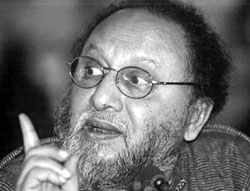 Southasia’s difficulties with Gandhi’s legacy
by Ashis Nandy
Nobody calls Gautam Buddha a Nepali, even though he was born at Lumbini in Nepal. If the Buddha seems too august or distant, neither is Rabindranath Tagore’s citizenship taken very seriously. If it were, there would have been at least some scattered demands for changing the Bangladeshi national anthem, now that the country has both a well-developed Muslim nationalism and a budding fundamentalist movement.
Mohandas Karamchand Gandhi’s case is different. Although much of the rest of the world may not emphasise his Indian origins, many Southasians do – and they do so in a particular fashion. Southasians constantly offset his ideas against his political practices, which they find contaminated by his Indian-ness and Hinduism, and find him wanting. After Gandhi’s assassination, no less than Albert Einstein said that future generations would find it hard to believe that such a person had walked the earth. Mohammed Ali Jinnah, however, mourned his death only as that of a great Hindu leader. Parts of Southasia are more ambivalent towards Gandhi than even the modern West – his avowed target – has ever been.
This ambivalence has to do not only with Gandhi’s politics, but also with the fact that he was a political figure. In recent times, Southasians have come to believe that the term ethical politics is an oxymoron; that politicians talking about ethics have to be either hypocrites, romantic visionaries, or irrelevant to the ‘real’ stuff of politics. When applied to the likes of Gandhi, in India too (despite its pretensions to the contrary) this belief is certainly not confined to a small section of Hindu nationalists or xenophobes: it includes a large number of radicals, liberals and globalisers. Gandhi tried to disinherit and decentre the middle class; the memory of that still hurts.
Southasia has lost something in the process. I am not a Gandhian, but as a psychologist and political analyst, I have worked off-and-on with Gandhian principles for many years. It has paid me rich dividends. I did not come to Gandhi willingly. Like most Bengalis, I maintained a healthy distance, and my discomfort with him was tinged with a touch of hostility. This unease was aggravated by my parents’ admiration for Gandhi: in my childhood, Gandhi represented authority. How many other Southasians may have a similar story?
-continued-
Himal Southasian magazine

Himal Southasian magazine happens to be based in Kathmandu, from where with increasing horror we have watched the evolution of the Maoist insurgency in Nepal – and in the latest instance, the palace activism in particular following the royal takeover of 1 February 2005. Looking out over the Southasian landscape, we realise that a country that had made relatively good progress as a democracy following the People’s Movement of 1990 is being forced backwards in time, by rebel and royalty alike. In the cover feature of this issue, we have charted the course of both of these forms of extremism, scrutinising the continuing warfare and sudden democratic deficit in the country where we happen to be based. We also believe that editors and reporters must stand up as citizens when a society’s most basic values are under threat.
Uncle Sam's Scientists Busy Building Insect Army

No, it's not an April Fool's joke: Defence research agency creates landmine-sniffing bugs
by Lynda Hurst
A rocky foreign terrain. Platoons of remotely controlled cyborg-insects sniffing out landmines, transmitting their location back to human handlers. Can you picture it? No? that's the difference between you and the scientists, "extreme thinkers," at DARPA, the Defence Advanced Research Projects Agency, where soldier insects are already in the works.
The agency's mandate is to maintain the technological superiority of the U.S. military through "far-future" thinking. Its cutting-edge, some would say lunatic-fringe, researchers give new meaning to the concept of brainstorming.
But way back at the dawn of computer time, circa 1969, they developed the precursor to the Internet, known as the ARPANET. They invented GPS, global positioning systems. They're credited, in fact, with half the major innovations in the high-tech industry, not to mention the 120-plus technologies they've come up with for the military, everything from the now standard M-16 rifle to stealth aircraft.
But back to the bugs.
DARPA's current big idea is to implant tiny microsystems into insects at the pupa stage of their development, when they can be "integrated" into their internal organs.
A step or three later, they could be turned into miniature unmanned vehicles for use on military missions "requiring unobtrusive entry into areas inaccessible or hostile to humans." Osama Bin Laden's cave, say.
But first things first. In its call for proposals from university researchers and private firms last month, DARPA said the immediate goal is "the controlled arrival of an insect within five metres of a specified target located 100 metres away. It must then remain stationary indefinitely, unless otherwise instructed ... to transmit data to sensors providing information about the local environment."
Dragonflies and moths are "of great interest," but "hopping and swimming insects could also meet final demonstration goals."
Or not. Similar research on honeybees and wasps in 2003 was, quite frankly, a wash-out.
-continued-
Car Wreck
 A friend e-mailed these to me, I'm not sure if, when, were, this happened, but I thought they were pretty fascinating examples of what happens when something moving at high speeds hits something stationary.

Virgin Mary coke ring busted

The Virgin Mary's been a busy girl lately. She's been spotted hanging out under a bridge in Moline, Illinois and just avoided being cast into a fire in Janesville, Wisconsin. Now the Feds have caught Mary helping a cocaine cartel smuggle the Devil's dandruff into Brooklyn, New York.
"Like grave robbers who have no respect for the dead, this drug organization used revered tombstones to smuggle millions of dollars worth of cocaine into New York City," said John Gilbride, the special agent in charge of the New York DEA office.
According to a Drug Enforcement Agency press release yesterday, five tombstones in the image of the Virgin were packed with cocaine were seized in a raid of a Brooklyn warehouse yesterday.
"They were dead wrong. We were on top of what they were doing. We seized their drugs and put an end to their organization," Gilbride said.
The DEA's total haul came to over 200 kilos of cocaine worth about $40 million. The 12 busts were a result of an 18-month investigation into a gang based out of Monterrey, Mexico with a network that distributes all over the country.
Damn you Chuck Norris!!!!

Dodgeball has been enjoying a renaissance over the past few years. In cities across the country people in their twenties and thirties are rediscovering the game of their youth. Tragically a Liberty, Missouri minister lost sight of the game's simple joys Wednesday.
A 16-year-old boy had minister David M. Boudreaux, 27, in his cross-hairs. His shot sailed wide of its target.
When the boy again got a hold of the ball he launched another salvo at Boudreaux. This time his aim was true. The ball smashed the minister in the face, sending his glasses flying.
The boy immediately offered an apology, but it fell on deaf ears.
Boudreaux went into a fit of rage. Rather than heeding his training manual, he struck back, knocking the boy to the ground.
After clambering back to his feet, the boy apologized again.
Unsatisfied by the boy's expressions of remorse, Boudreaux pulled back his foot and sent it right into the boy's groin and stormed of in a huff.
Since the savage attack, the boy has suffered whiplash and post-concussion syndrome. He's also had quite a bit of blood in his urine.
Boudreaux has since apologized. He is currently on administrative leave from Crescent Lake Christian Academy.
Hugo Chavez starts 9/11 investigation

It's one of the most bizarre turns in the ever-growing Sept. 11 scandal.
Venezuelan president Hugo Chavez has launched a government investigation of the 9/11 attacks in the United States -- his government vs. the government led by George W. Bush.
A pair of well-known Sept. 11 skeptics have traveled to Venezuela to help probe what they say is a massive cover-up in Washington and New York.
Billionaire Jimmy Walter and World Trade Center hero William Rodriguez arrived in Caracas this week and are expected to meet with Chavez both in private and on his popular weekly radio show, "Alo Presidente."
"Rodriguez was the last survivor pulled from the rubble of the north tower of the WTC, and was responsible for all stairwells within the tower," alternative-news site Prison Planet reported today.
"Rodriguez represented family members of 9/11 victims and testified to the 9/11 Commission that bombs were in the north tower but his statements were completely omitted from the official record."
Walters and Rodriguez say U.S. intelligence agents are tracking them on the ground in Venezuela, and that they were both put on a U.S. "no fly" list to try to keep them from meeting with Chavez.
God or the gal?
 -The original version of this show had young boys, but the censors wouldn't allow it. Plus volunteers for the show were hard to come buy, on the kid side, and overwhelming on the priest side.-
Catholics are furious about a new "reality TV show" that pits men called to the priesthood against sexy young gals.
"God or the Girl?" will premiere on Easter Sunday, of all days, on the A&E network.
The five-part series tracks the lives of "four young men trying to decide whether to enter the Catholic priesthood," according to Fox News.
All of the men are in their 20s, and all apparently are sexually attracted to women.
Joe Adair, 28, Dan DeMatte, 21, Steve Horvath, 25, and Mike Lechniak, 24, are the real-life stars of the program.
To either weed out these seemingly normal young men or make them crazy enough to take the Vatican's vow of celibacy, the four would-be priests are commanded to do ridiculous things to prove their faith.
"Adair goes on a pilgrimage with no money or food, relying completely on the kindness of strangers to help him get to his destination -- a religious center in Niagara Falls," reporter Catherine Donaldson-Evans writes.
"DeMatte builds an 80-pound cross and carries it 22 miles. Horvath travels to a mission in Guatemala to work with people living in extreme poverty. Lechniak goes on a retreat and stays with nuns."
The Vatican invented the "vow of celibacy" for priests in order to keep priests from having children. Without heirs, any property owned by priests would always go back to the church.
(Women were accepted by the church as priests until the 4th Century, and even as late as the 1400s some bishops complained that plenty of women were still ordained as priests and were hearing confessions.)
While some Catholic clergy were celibate in the church's early history, the Catholic law of celibacy arrived in fits and starts over many centuries.
One such law was widely ignored in the 9th Century -- a time of outrageous greed, corruption and depravity for the church, although by no means the last dark era for the Vatican.
"Council of Aix-la-Chapelle openly admitted that abortions and infanticide took place in convents and monasteries to cover up activities of uncelibate clerics," says a timeline of the church's History of Celibacy.
"St. Ulrich, a holy bishop, argued from scripture and common sense that the only way to purify the church from the worst excesses of celibacy was to permit priests to marry."
A century earlier, St. Boniface told the pope that in Germany, "almost no bishop or priest was celibate." Similar reports came from all over Europe.
But by the 1500s, only about half of priests were known to be married.
Throughout the church's history, seven popes were known to be married and 11 popes were the sons of Catholic clergy.
Just in the last 900 years, six popes were known to have children.
Nobody knows how many Catholic clergy lived "in sin" with women, whether nuns or civilians, or how many hundreds of thousands of children have been fathered by priests.
But today -- even as the Vatican regularly ordains married priests converting from other denominations -- priests of the Western world are expected to be celibate or at least live alone, "married to the church."
For countless thousands of children molested by these priests living an unnatural life, being married to the church hasn't been nearly enough to keep clergy from molesting kids.
Giant booze cloud!

Astronomers have discovered a massive cloud of alcohol deep in space.
British space scientists found the huge supply of interstellar booze in a region of our galaxy called W3(OH). It's where "stars are being formed by the gravitational collapse of a cloud of gas and dust," Lab News Online reported today.
But the killjoy astronomers don't want anybody getting any fun ideas about the space cloud or anything else.
"Although it is exciting to discover a cloud of alcohol almost 300 billion miles across, unfortunately methanol, unlike its chemical cousin ethanol, is not suitable for human consumption," said Dr. Harvey Smith from the Jodrell Bank Observatory.
Unfortunatly Coors, and Bud failed to read the whole story, and have started a billion dollar space race, in the hopes of opening the first pub in space.
Subscribe to:
Posts (Atom)

-
Who invented the noodle is a hotly contested topic - with the Chinese, Italians and Arabs all staking a claim. But the discovery of a pot of...
-
I work for a rather large company, and before that I worked for a huge company. Both companies had one thing in common, and I see this trend...

